Piano Keys Explained for Beginners
Learn how piano keys work: white and black key patterns, note names, sharps and flats, keyboard sizes, and simple ways to find any key.
Quick Answer
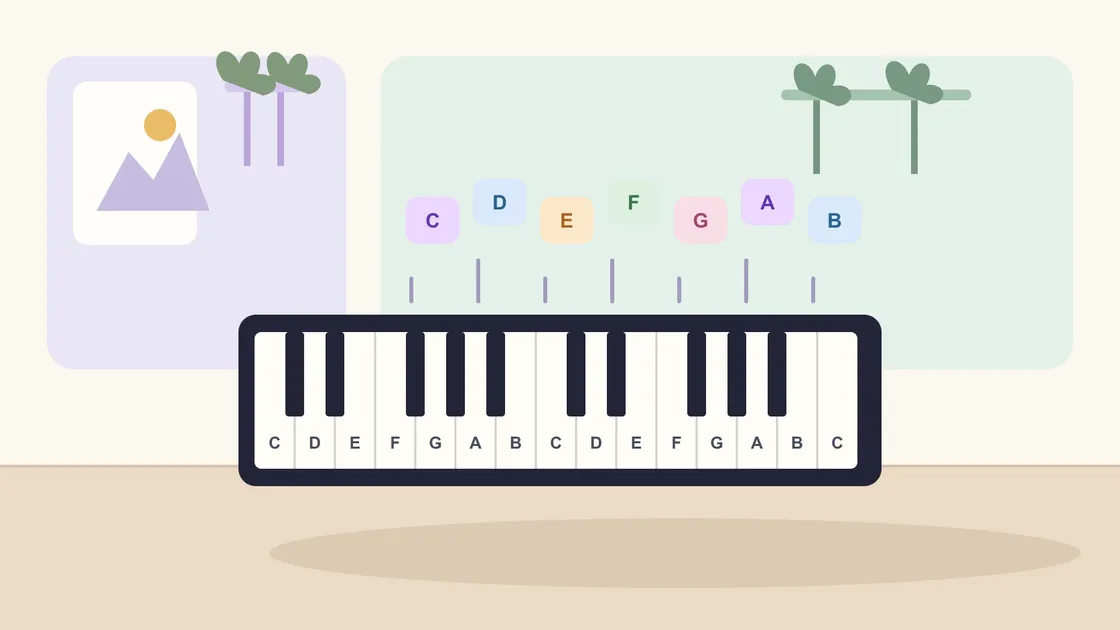
Piano keys repeat the same pattern across the keyboard. The white keys use the letter names C, D, E, F, G, A, and B. The black keys appear in a group of two, then a group of three. To find C, look for two black keys and play the white key immediately to their left. To find F, look for three black keys and play the white key immediately to their left. Once you know those two landmarks, the whole keyboard becomes much easier to read.
What Makes Piano Keys Easier Than They Look
An 88-key piano can look intimidating at first. The useful news is that you are not learning 88 unrelated things. You are learning one small shape that repeats from low notes on the left to high notes on the right.
That repeating shape has three parts:
- seven white-key note names: C, D, E, F, G, A, and B
- a group of two black keys
- a group of three black keys
The notes become higher as you move right and lower as you move left. The names repeat, but the pitch changes. For example, a C near the left end sounds much lower than a C near the right end.
For a deeper introduction to the note names themselves, read Piano Notes for Beginners.
The White And Black Key Pattern
The quickest way to understand piano keys is to use the black keys as landmarks. They never appear as a random row. They repeat in groups of two and three.
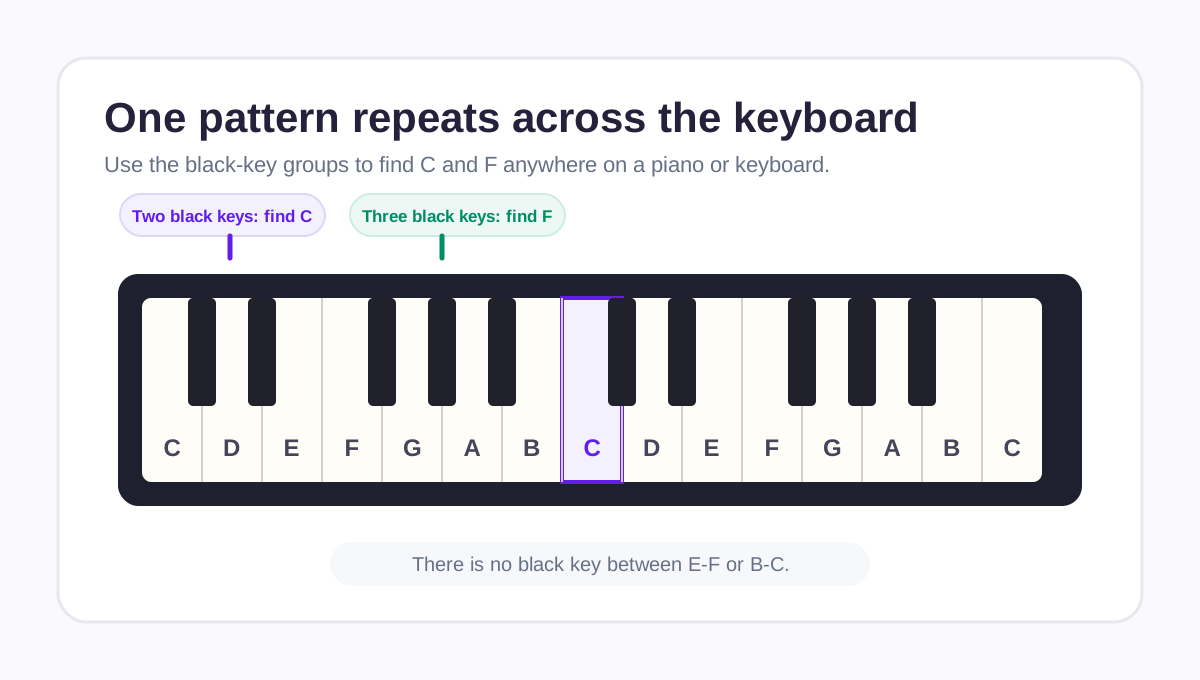
The white keys around each group follow the same pattern:
- C is immediately left of two black keys.
- D sits between the two black keys.
- E is immediately right of two black keys.
- F is immediately left of three black keys.
- G, A, and B follow across the three-black-key group.
- The next white key is C again.
You do not need stickers on every key. Learn this one pattern, then look for it again anywhere on the instrument.
How To Find Any White Key
Start with a landmark instead of counting from the far left of the keyboard.
Find C
- Find a group of two black keys.
- Play the white key directly to the left of that group.
- You have found C.
Find F
- Find a group of three black keys.
- Play the white key directly to the left of that group.
- You have found F.
From C, move right to find D and E. From F, move right to find G, A, and B. This is more reliable than trying to memorize the keyboard as one long line.
Why There Is No Black Key Between E-F Or B-C
There is no black key between E and F. There is also no black key between B and C.
Those pairs sit next to each other on the piano. This is why the black keys naturally form groups instead of appearing between every pair of white keys.
At the beginning, treat E-F and B-C as two fixed pairs to recognize. They are part of the keyboard pattern, not exceptions you need to solve.
What The Black Keys Are Called
A black key can usually have two names. For example, the black key between C and D can be called C sharp because it is one key higher than C. It can also be called D flat because it is one key lower than D.
For a beginner, it is enough to understand the direction:
- a sharp moves one key to the right
- a flat moves one key to the left
You will meet these names in songs and sheet music, but do not try to memorize every sharp and flat before you can comfortably find the white-key landmarks.
How Many Piano Keys Do Beginners Need?
An 88-key piano is ideal for long-term repertoire, but beginners do not need all 88 keys to learn properly. What matters first is full-size keys, touch sensitivity, and a stable setup.
| Key count | Practical beginner use |
|---|---|
| 88 keys | Best long-term range |
| 76 keys | Plenty for most early learning |
| 61 keys | Enough for serious beginner learning |
| 49 keys or fewer | Better for exploration than regular piano study |
A 61-key keyboard can support serious early learning and many beginner songs. Later, an 88-key digital piano gives more range for left-hand patterns, larger pieces, and long-term progress.
Read Best Piano Keyboard for Beginners for a practical buying guide, including key feel, stands, and home setup.
Piano Keys, Touch, And Key Size
The number of keys matters, but it is not the only decision. A keyboard with full-size, touch-sensitive keys is usually more helpful than a smaller toy-style keyboard with many extra sounds.
Look for:
- Full-size keys: help your hands learn normal spacing.
- Touch sensitivity: lets the sound respond when you play more softly or firmly.
- A stable stand or cabinet: keeps the keyboard at a comfortable height.
- A comfortable bench or chair: supports relaxed shoulders and hands.
Weighted keys are useful when you want a piano-like feel, especially for long-term practice. They are not required for the first few lessons, but they are a meaningful advantage as technique develops.
Where Is Middle C On The Keyboard?
Middle C is the C near the center of the piano. It is still the white key immediately left of two black keys, but its location near the middle makes it especially useful for beginner songs and sheet music.
Use this quick check:
- Find a two-black-key group near the center of the instrument.
- Play the white key directly to its left.
- Check that you are close to the middle range, not at either end.
That is middle C. It is a useful bridge between your keyboard layout and written music. See What Is Middle C on Piano? for a step-by-step guide.
A Five-Minute Piano-Key Exercise
Use this short exercise on a few different days. It works for adults and children.
- Find every group of two black keys.
- Play the C to the left of each group.
- Find every group of three black keys.
- Play the F to the left of each group.
- Pick one C near the middle and play C-D-E-F-G slowly.
- Move one octave higher and repeat the same five notes.
Say the note names quietly while you play. The goal is not speed. It is to make the visual pattern, note name, and finger movement feel connected.
For Adult Beginners And Parents
Adult beginners often benefit from learning the keyboard pattern before trying to read every note on the staff. It removes the feeling that the instrument is a maze and makes short practice sessions more focused.
For children, turn the pattern into a game. Ask them to find a group of two black keys, then find C. Next ask them to find a group of three, then find F. Short repeated challenges work better than a long memorization session.
In tonestro, beginner piano exercises and songs give learners repeated chances to use the same key landmarks in real music. That is how the pattern becomes familiar: not by looking at a chart once, but by returning to it while playing.
Common Piano-Key Mistakes
Avoid these common early mistakes:
- trying to count every key from the far left
- assuming a black key sits between every pair of white keys
- treating every C as the same pitch
- relying on stickers for too long
- choosing a keyboard only for its extra sounds instead of its key feel
The fix is simple: return to the two-and-three black-key pattern. It gives you a repeatable way to check your position on any piano or keyboard.
Related Reading
- Piano Notes for Beginners
- What Is Middle C on Piano?
- How to Read Sheet Music for Piano Beginners
- Best Piano Keyboard for Beginners
- How to Learn Piano for Beginners
- 15-Minute Piano Practice Routine for Beginners
FAQ
How do piano keys work?
Piano keys repeat a pattern of seven white-note names, C through B, with black keys arranged in groups of two and three. Use the two-black-key group to find C and the three-black-key group to find F.
What are the white keys on a piano called?
The white keys are named C, D, E, F, G, A, and B. After B, the pattern starts again at C in the next octave.
Why are piano keys black and white?
The colors make the keyboard pattern easier to see. White keys show the basic note names, while black keys sit between selected pairs of white keys and represent sharps or flats.
Why are there only two or three black keys together?
There is no black key between E-F or B-C. That creates the repeating group of two black keys, followed by a group of three.
How do I find C on a piano?
Find any group of two black keys. C is the white key directly to the left of that group.
Are 61 keys enough to learn piano?
Yes. A 61-key keyboard with full-size, touch-sensitive keys is enough for serious beginner learning and many early songs. An 88-key instrument offers more range later.
Should beginners label piano keys?
Temporary labels can help at the beginning, especially for children. Use them sparingly and remove them gradually so the black-key pattern becomes the main guide.
Last updated