15-Minute Piano Practice Routine for Beginners
A simple 15-minute piano practice routine for beginners, with warm-up, notes, rhythm, song practice, review, and tips for adults and children.
Quick Answer
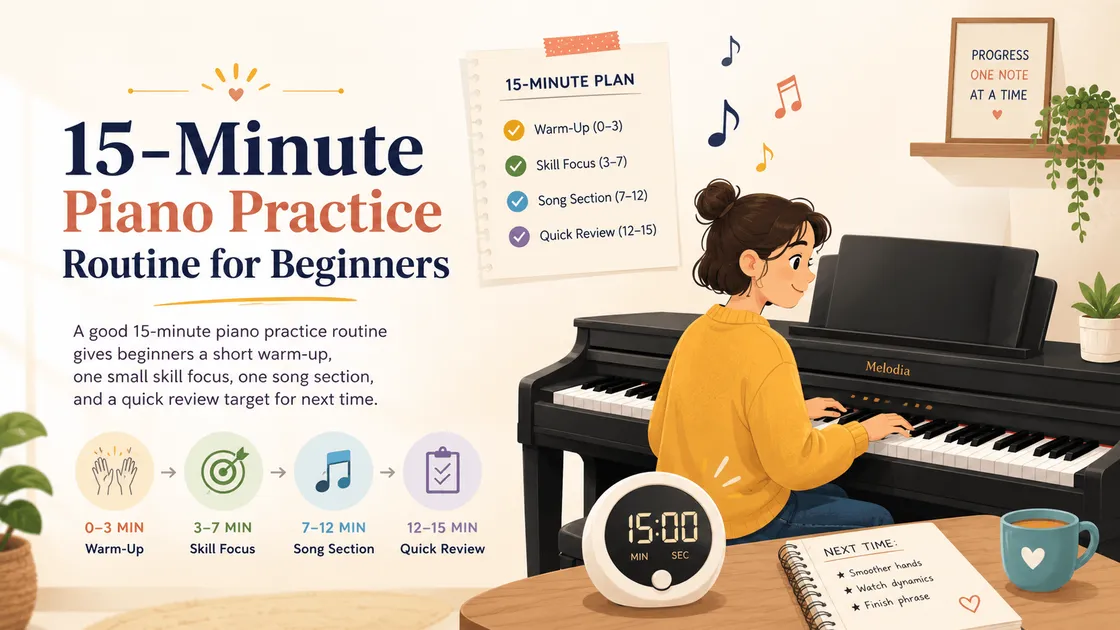
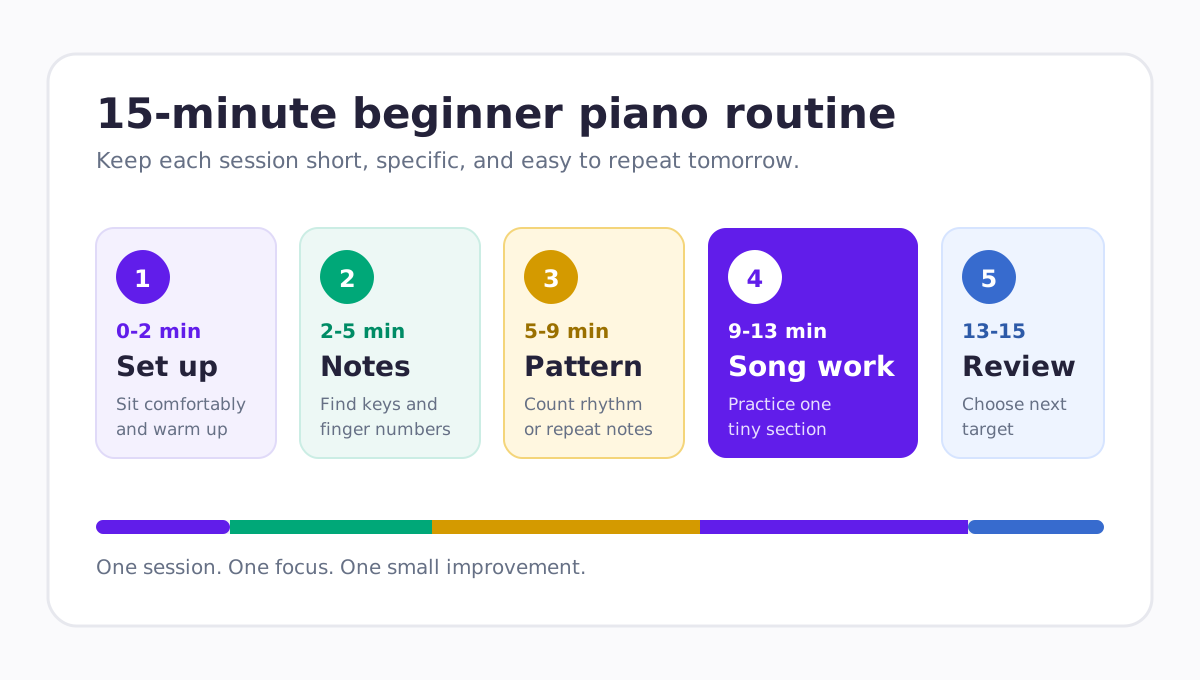
A good 15-minute piano practice routine for beginners includes a short setup, one focused skill, one small song section, and a quick review. Use the first 2 minutes to sit comfortably and warm up, minutes 2-5 to find notes or finger numbers, minutes 5-9 to practice rhythm or a short pattern, minutes 9-13 to work on one tiny song section, and the final 2 minutes to repeat what improved and choose the next practice target.
Why 15 Minutes Is Enough To Start
Beginners often think piano practice only counts if it is long. In reality, a short practice session can be very effective if it has a clear purpose.
Fifteen minutes is long enough to repeat something several times, notice one problem, and improve it. It is also short enough to fit into normal life. That matters for adult beginners after work, parents helping children, and anyone trying to build a new habit without making piano feel overwhelming.
The key is focus. Fifteen distracted minutes will not do much. Fifteen minutes with a clear plan can help a beginner move forward almost every day.
The 15-Minute Routine At A Glance
Use this structure as your default beginner session.
| Time | Focus | What To Do |
|---|---|---|
| 0-2 minutes | Set up and warm up | Sit comfortably, relax your shoulders, play five nearby notes slowly |
| 2-5 minutes | Notes and fingers | Find C, D, E, F, and G, or review finger numbers |
| 5-9 minutes | Rhythm or pattern | Clap a rhythm, count out loud, or play a five-finger pattern |
| 9-13 minutes | Song section | Practice one small part of a beginner song |
| 13-15 minutes | Review | Repeat the best version and choose tomorrow’s target |
This routine works because it avoids the most common beginner mistake: playing a whole song from the beginning again and again without fixing the part that actually needs attention.
Minute 0-2: Sit, Relax, And Warm Up
Start by making the instrument comfortable.
Check that:
- your bench or chair is stable
- your shoulders are relaxed
- your elbows are not locked
- your wrists are not collapsing downward
- your feet can rest comfortably
Then play five neighboring white keys slowly. A simple choice is C-D-E-F-G and back down: G-F-E-D-C.
Play with one hand first, then the other hand. Do not worry about speed. The goal is to connect your eyes, fingers, and ears before the real practice begins.
Minute 2-5: Find Notes And Finger Numbers
The next few minutes should help you feel less lost on the keyboard.
Good beginner options include:
- Find every C on the keyboard.
- Find C, D, and E near middle C.
- Say the note names out loud while playing.
- Review right-hand finger numbers 1-2-3-4-5.
- Review left-hand finger numbers 5-4-3-2-1.
If note names still feel confusing, use the black keys as landmarks. C is the white key just to the left of a group of two black keys. F is the white key just to the left of a group of three black keys.
This connects directly to note reading. The faster you can find notes on the keyboard, the easier beginner songs become.
Minute 5-9: Practice One Small Pattern
Choose one pattern and repeat it carefully.
For example:
| Pattern | How To Practice It |
|---|---|
| Five-finger pattern | Play C-D-E-F-G-F-E-D-C slowly |
| Simple rhythm | Clap quarter notes while counting 1-2-3-4 |
| Note jumps | Move from C to G, then back to C |
| Left-hand bass notes | Play low C, then middle C |
| Hands separately | Play the right hand only, then the left hand only |
Keep the pattern small. If you make the same mistake three times, the pattern is probably too fast or too long. Slow down, or practice fewer notes.
This is where beginners make real progress. The goal is not to play many different things. The goal is to make one small thing more reliable.
Minute 9-13: Work On One Tiny Song Section
Now practice music, but keep the section short.
A good section might be:
- one line of a beginner song
- two measures that feel difficult
- the right hand of a melody
- the left hand alone
- the first phrase of a piece
Start with the hardest small section, not always the beginning. Beginners often know the first two measures best because they restart there after every mistake. The difficult part usually needs more attention.
Use this order:
- Clap or count the rhythm.
- Play the notes with one hand.
- Repeat slowly.
- Add the other hand only if the section feels stable.
If both hands are too difficult, that is normal. Practice hands separately first. Two-hand coordination is built gradually.
Minute 13-15: Review And Set The Next Target
End the session with something specific.
Play the best version of the section once more. Then write one short practice note, such as:
- “Tomorrow: measures 3-4 slowly.”
- “Remember: count before playing.”
- “Good today: found C without labels.”
- “Need work: left hand enters late.”
This small note makes the next session easier to start. It also helps beginners see progress, because improvement is often small from day to day.
A Weekly Beginner Practice Plan
You can repeat the same 15-minute structure while changing the focus each day.
| Day | Main Focus | Song Work |
|---|---|---|
| Monday | Keyboard note names | Right-hand melody |
| Tuesday | Rhythm counting | Clap, then play |
| Wednesday | Left-hand notes | Add simple bass notes |
| Thursday | Hands separately | Practice each hand slowly |
| Friday | Two-hand coordination | Connect one small section |
| Saturday | Review | Play favorite sections |
| Sunday | Light practice or rest | Listen, review, or take a break |
Rest is allowed. A sustainable routine is better than a perfect schedule that only lasts one week.
How Often Should Beginners Practice Piano?
Beginners should aim for short, regular practice. Four or five focused sessions per week are better than one long session followed by several days off.
A useful starting goal is:
- 10-15 minutes per session for young children
- 15-20 minutes per session for adult beginners
- 4-5 practice days per week
- one clear focus per session
Daily practice can work well, but it should not feel like punishment. The goal is to make piano normal, repeatable, and realistic.
Should Beginners Use A Metronome?
A metronome can help, but it is not always the first tool a beginner needs.
If you are still searching for every note, the metronome may add pressure. First, count out loud. Then clap the rhythm. Then play slowly without the metronome. Add the metronome when the notes are familiar enough that you can listen to the beat.
Start slower than you think. A slow tempo that stays steady is better than a fast tempo that falls apart.
Practice Tips For Adult Beginners
Adult beginners often practice with too much self-judgment. Try to treat practice as training, not as proof of talent.
Use these rules:
- Make the task smaller when you repeat the same mistake.
- Practice slowly enough that your hands can succeed.
- Record a short audio clip once per week.
- Track one thing that became easier.
- Do not compare your progress with someone who started years ago.
Adults usually understand concepts quickly, but the hands still need repetition. That gap is normal. Short, patient practice closes it.
Practice Tips For Parents
For children, 15 minutes can be a lot. Split the routine into smaller blocks if needed.
For example:
| Child-Friendly Version | What To Do |
|---|---|
| 3 minutes | Find notes as a game |
| 5 minutes | Play one short pattern |
| 5 minutes | Practice one song line |
| 2 minutes | End with a favorite part |
Parents should praise specific actions, not only correct notes.
Useful phrases include:
- “You found middle C quickly.”
- “You counted before playing.”
- “You fixed that measure by slowing down.”
- “You noticed the mistake yourself.”
Specific praise teaches children what good practice looks like.
Common Beginner Practice Mistakes
Avoid these habits:
- Restarting from the beginning after every mistake.
- Playing everything too fast.
- Practicing for a long time without a clear goal.
- Changing songs too quickly.
- Ignoring rhythm and only thinking about note names.
- Practicing with tense shoulders and hands.
The solution is usually simple: choose a smaller section, slow down, and repeat it with attention.
How To Know The Routine Is Working
The routine is working if starting feels easier, mistakes become more specific, and small sections improve.
A beginner might first say, “This song is hard.” After better practice, they can say, “The left hand enters late in measure four.” That is progress. A clear problem is easier to fix than a vague feeling of failure.
You may also notice that simple music begins to sound calmer and steadier. Beginner progress is not only about playing harder songs. It is also about making easy music sound more controlled.
Related Reading
FAQ
Is 15 minutes of piano practice enough for beginners?
Yes. For beginners, 15 focused minutes several times per week can build a strong habit and steady progress. Longer sessions can help later, but consistency matters more at the start.
What should a beginner practice first on piano?
A beginner should start with comfortable posture, note names, finger numbers, simple rhythm, and short beginner songs. The first goal is to make the keyboard feel familiar.
Should beginners practice piano every day?
Daily practice can help, but it is not required. Four or five focused sessions per week are a realistic and effective starting point for many beginners.
Should children use the same 15-minute piano routine?
Children can use the same routine, but it may work better split into shorter blocks. Five focused minutes can be more useful than 15 distracted minutes.
What is the biggest mistake beginners make when practicing piano?
The biggest mistake is restarting from the beginning after every error. Beginners improve faster when they practice the difficult small section directly and slowly.
Last updated