Piano Notes for Beginners
Learn the piano note names, how the keyboard pattern works, where middle C is, and how beginners can start connecting notes to the staff.
Quick Answer
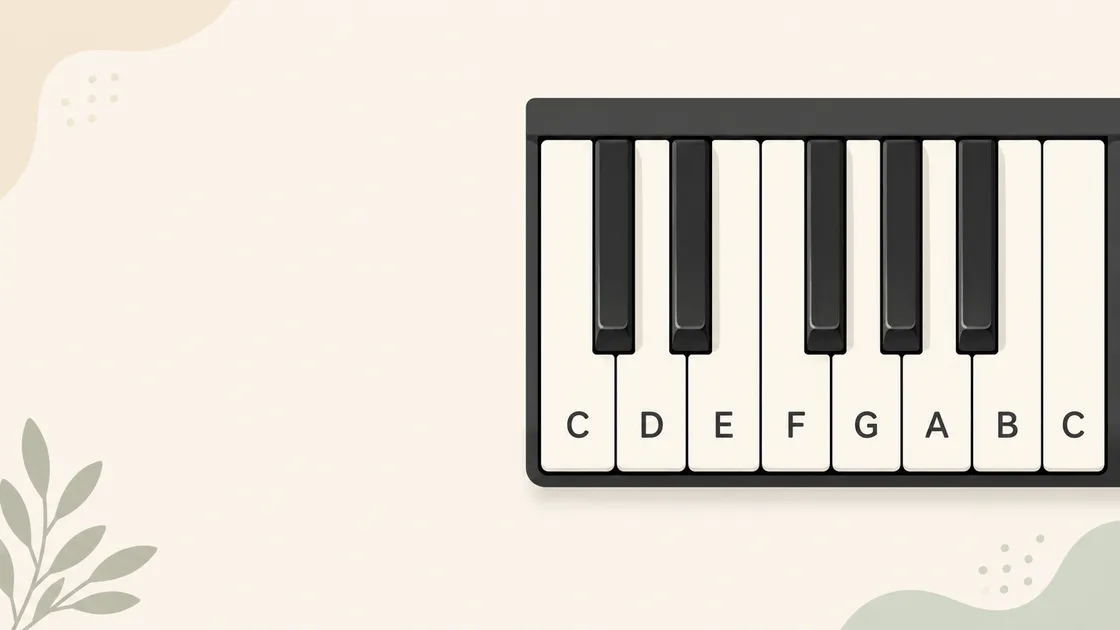
The white keys on a piano use seven note names: C, D, E, F, G, A, and B. After B, the pattern starts again at C. The black keys appear in repeating groups of two and three, and those groups help you find the white notes. For beginners, the most useful first landmark is middle C, which sits near the center of the keyboard and is often used in early piano lessons.
The Seven Piano Note Names
Piano notes repeat in alphabetical order:
C D E F G A B
Then the pattern starts again:
C D E F G A B
This means there are not dozens of different note names to memorize. There are seven letter names repeated across the keyboard at different pitches.
The C on the left side of the keyboard sounds lower. The C on the right side sounds higher. They share the same note name because they belong to the same letter group, but they are in different octaves.
An octave is the distance from one note to the next note with the same name. For example, C to the next C is one octave.
Use The Black Keys As Landmarks
The easiest way to find notes is to look at the black keys. They appear in repeating groups:
- two black keys
- three black keys
- two black keys
- three black keys
These groups are the map of the keyboard.
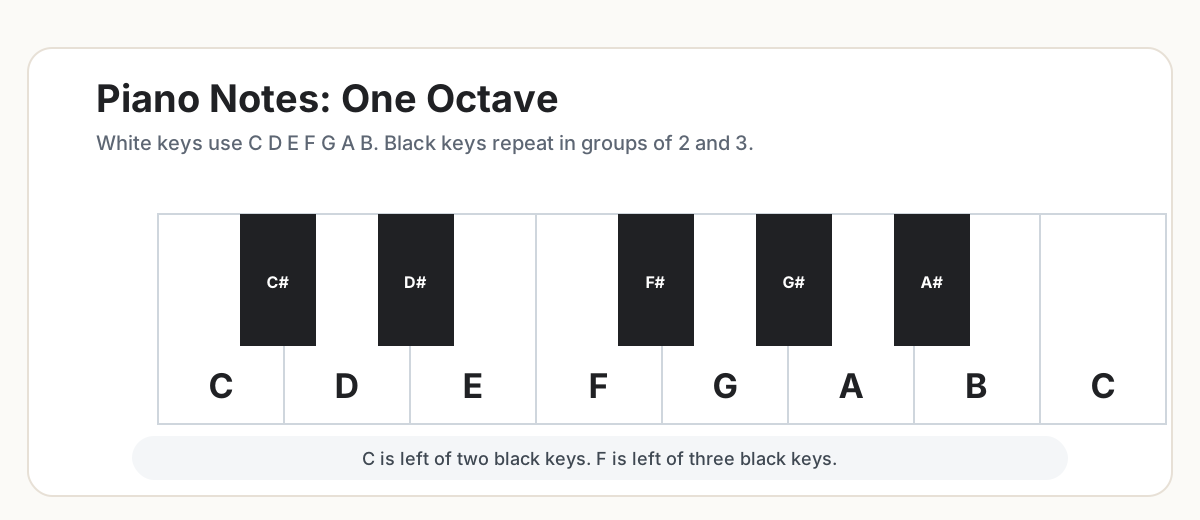
C is the white key immediately to the left of a group of two black keys. F is the white key immediately to the left of a group of three black keys.
Once you can find C and F, the rest of the white notes become much easier. From C, count up to D and E. From F, count up to G, A, and B.
White Keys On The Piano
The white keys use the letter names C, D, E, F, G, A, and B.
Here is one octave:
| White Key | How To Find It |
|---|---|
| C | Left of two black keys |
| D | Between the two black keys |
| E | Right of two black keys |
| F | Left of three black keys |
| G | First white key after F |
| A | Next white key after G |
| B | Next white key after A |
Then the next key is C again.
Beginners should not try to memorize every key separately. Learn the pattern once, then repeat it across the keyboard.
Where Is Middle C?
Middle C is the C near the center of the keyboard. On an 88-key piano, it is close to the middle of the instrument, slightly left of center.
To find middle C:
- Look near the center of the keyboard.
- Find a group of two black keys.
- Play the white key immediately to the left of that group.
That note is C. If it is near the center of the keyboard, it is middle C.
Middle C matters because beginner piano music often starts near it. It is also a bridge between the right-hand and left-hand reading areas on the staff.
What Are Sharps And Flats?
The black keys are usually named as sharps or flats.
A sharp means the note is raised by one key. C sharp is the black key immediately to the right of C.
A flat means the note is lowered by one key. D flat is the same black key as C sharp, because it is immediately to the left of D.
This means one black key can have two names. That can feel strange at first, but beginners do not need to master every sharp and flat immediately.
Start with the white-key notes. Then add black-key names as they appear in songs.
Why Are There No Black Keys Between Some White Keys?
There is no black key between E and F. There is also no black key between B and C.
This is normal. The piano keyboard does not place a black key between every pair of white keys.
Many beginners expect every white key to have a black key after it. When that does not happen, B-C and E-F can feel confusing. Use the black-key groups to stay oriented.
If you see two white keys with no black key between them, they are either E-F or B-C.
Piano Notes On The Staff
Piano music is usually written on two staves:
- the treble clef, often played by the right hand
- the bass clef, often played by the left hand
Middle C sits between these two staves. It can appear just below the treble staff or just above the bass staff on a small extra line called a ledger line.
Do not try to memorize every staff note in one day. Start with landmarks:
| Landmark | Where It Appears | Why It Helps |
|---|---|---|
| Middle C | Between treble and bass staff | Connects both hands |
| Treble G | Second line of the treble staff | Gives the treble clef its name |
| Bass F | Fourth line of the bass staff | Gives the bass clef its name |
Once you know a landmark, nearby notes can be found by stepping up or down: line, space, line, space.
Connect Written Notes To The Keyboard
Reading notes is not only naming letters. You need to connect three things:
- The note on the page.
- The key on the keyboard.
- The finger movement that plays it.
At first, this feels slow. That is normal. With practice, the steps begin to connect.
When you see a written note, ask:
- What is the note name?
- Where is that note on the keyboard?
- Which finger can play it comfortably?
This is how reading becomes playing.
Should Beginners Label Piano Keys?
Temporary labels can help at the very beginning, especially for children. But labels should not become permanent.
The goal is to recognize the keyboard pattern, not to read stickers forever.
If you use labels, keep them simple. Label only a small section around middle C, then remove labels gradually.
Adult beginners often do better by saying note names out loud while playing. Saying “C, D, E” while pressing the keys connects sight, movement, and memory.
A Five-Minute Note-Finding Exercise
Try this exercise for a few days:
- Find every C on the keyboard.
- Find every F.
- Play C-D-E slowly with your right hand.
- Play F-G-A-B slowly.
- Close your eyes, open them, and find middle C again.
This turns the keyboard from a long row of identical keys into a repeating map.
You can also play the “two-second find” game. Say a note name, then try to find it within two seconds. If that is too fast, use five seconds. The goal is not pressure. The goal is automatic recognition over time.
Common Beginner Confusions
One common confusion is thinking the piano starts on C. A full 88-key piano starts on A at the far left, but beginners often learn C first because it is easy to find using the two-black-key group.
Another confusion is mixing up B-C and E-F. These pairs have no black key between them.
A third confusion is thinking that every C is the same pitch. Every C has the same letter name, but C notes in different octaves sound higher or lower.
How Parents Can Help Children Learn Notes
Parents do not need to know piano perfectly to help a child learn note names.
Ask simple questions:
- Can you find two black keys?
- Which white key is just to the left?
- Can you find another C?
- Can you find C near the middle of the keyboard?
Keep the exercise short. Children often learn note names better through small games than long explanations.
Praise the strategy, not only the result. For example: “You used the two black keys to find C.”
Related Reading
- How to Learn Piano for Beginners
- Best Piano Keyboard for Beginners
- 15-Minute Piano Practice Routine for Beginners
FAQ
What are the 7 notes on piano?
The seven note names are C, D, E, F, G, A, and B. They repeat across the keyboard.
Why do piano notes start with C for beginners?
Beginners often start with C because it is easy to find using the group of two black keys. A full piano starts on A at the far left, but C is a more useful beginner landmark.
Where is middle C?
Middle C is the C near the center of the keyboard. Find a group of two black keys near the middle, then play the white key immediately to the left.
Should I learn white keys before black keys?
Yes. Learn the white-key pattern first, then add sharps and flats. This makes black-key names easier to understand.
How do I memorize piano notes faster?
Use landmarks instead of random memorization. Find C and F from the black-key groups, then count to nearby notes.
Is it okay to label piano keys?
Temporary labels are okay, especially for children, but remove them gradually. The long-term goal is to recognize the keyboard pattern without labels.
Last updated