
The short answer
- First note
- Instant: press a key and the tone is there.
- First song
- Ten minutes: you play one or two notes with a band in a real song.
- A common hurdle
- Two hands doing different things.
- What helps
- Each hand alone first, then both together slowly.
The three real hurdles
- Two hands, two jobs
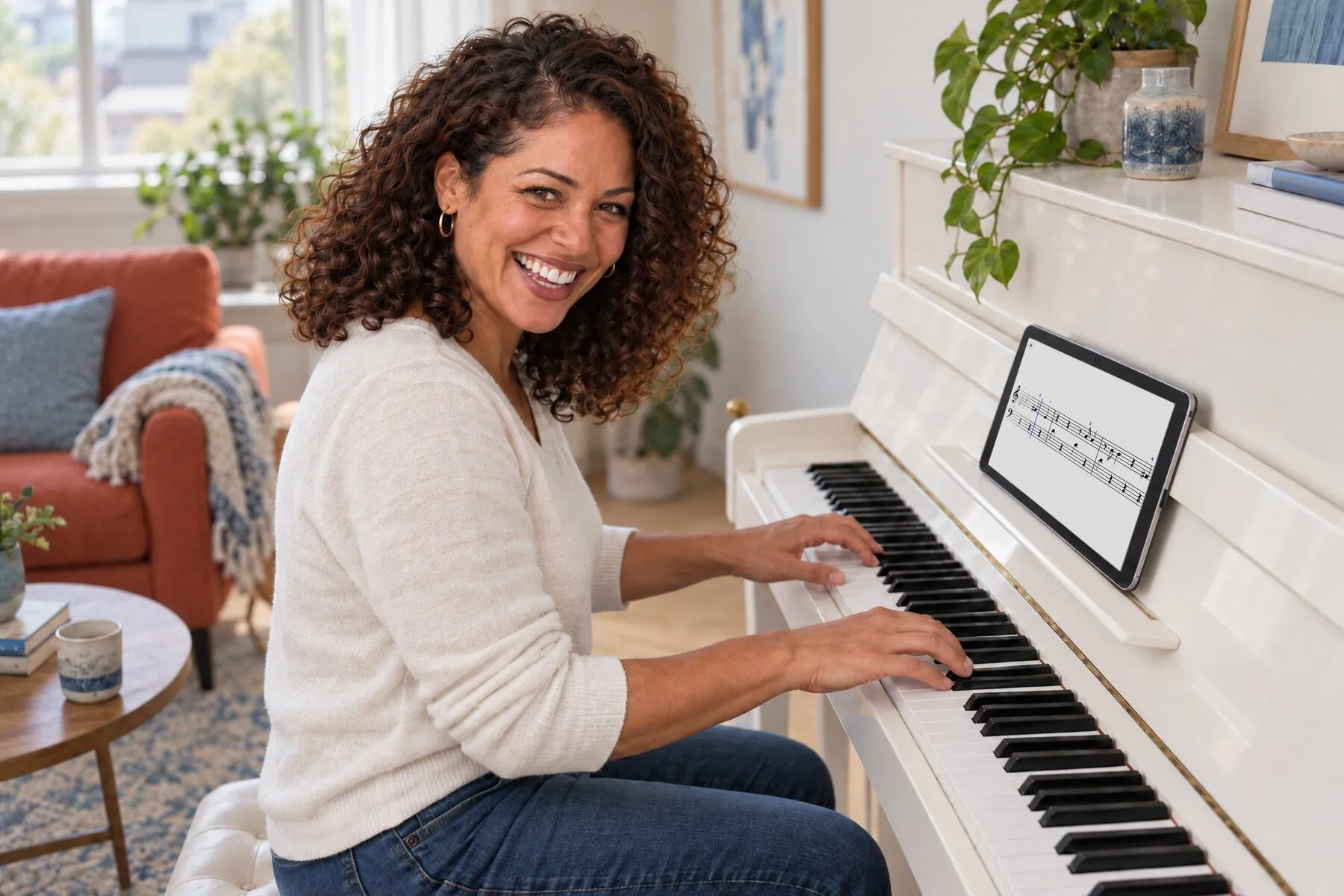
Often the right hand plays the melody while the left holds longer notes or repeats a pattern. Your brain has to run both at once, and at first your hands want to copy each other.
What helps: Practice a short section with each hand, then combine both slowly once the notes and rhythm feel familiar. In tonestro you can slow the passage down for this and speed up once it runs steadily.
- Two staves to read
Piano music uses a treble clef, usually for the right hand, and a bass clef, usually for the left. The same line stands for a different note in each, which feels like reading two alphabets.
What helps: Learn a few landmark notes, such as middle C (C4), and find the others from there. Reading grows step by step as you play.
- Holding a steady beat
When a passage gets tricky, it's tempting to slow down or stop, and the rhythm falls apart.
What helps: Choose a tempo you can keep from the first note to the last. tonestro shows you right away whether each note came in time.
Easier than you think
- The tone is ready. On the piano you don't have to shape a tone first. That leaves your attention free for notes and rhythm from day one.
- The keyboard is a pattern. Twelve keys, seven white and five black, repeat from the bottom to the top. Once you can find C, just left of each pair of black keys, you can find every other note.
- Five notes go a long way. Simple melodies can get by with five neighboring white keys, such as C to G. You don't need to know the whole keyboard to play real music.
More answers
- Will I really play my first song in 10 minutes?
- How does tonestro hear me play?
- Can I learn an instrument without a teacher?
Questions about the difficulty
Is piano hard if I have no musical background?
You don't need any musical background to start. You learn notes, a steady beat and how your hands work together step by step as you play. What the start looks like: piano for adult beginners.
Can I learn piano with small hands?
Yes. Simple melodies keep your hand in a small space, so hand size hardly matters at first. An octave spans twelve semitones, for example C4 to C5, and many beginner arrangements don't ask you to play both notes of an octave at once with one hand.
Is it harder to learn on a keyboard than on a piano?
Not at the start. Unweighted keys feel lighter than a piano's, so if you move to a piano later, give your fingers a little time to adjust.
When does piano start to feel easier?
Familiar passages often feel easier as you repeat them slowly; new rhythms and accompaniment patterns can challenge your coordination again. The phases in detail: a realistic piano timeline.
Updated: