
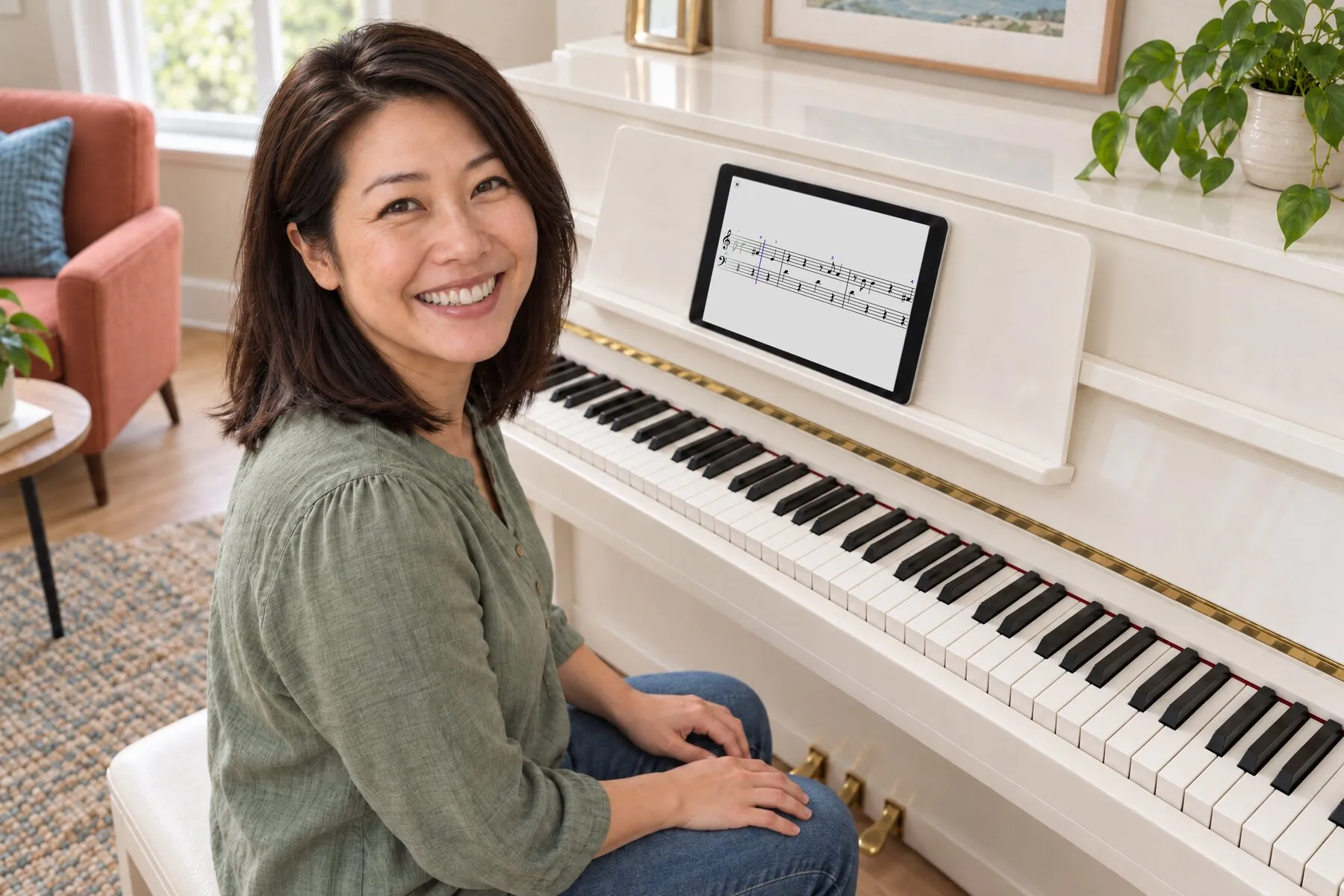
What you can do on your own
- Learn the keyboard and the notes. Finding keys, reading notes and counting beats are things you learn at home, lesson by lesson, in courses made by music teachers.
- Set your own goals. Choose one short section and one clear goal for each session, such as playing it through without stopping.
- Play real songs. The song library adds pieces beyond the course, so you have more music to practice.
Three typical self-study mistakes
- A different finger every time
Without a fixed fingering, you run out of fingers in the middle of a passage, and every repetition feels new.
What helps: Where the music shows finger numbers, 1 is the thumb and 5 the little finger, in either hand. Once a fingering works, use it every time.
- Tense hands, collapsing joints
If you press harder than needed, raise your shoulders or let your finger joints collapse, playing gets tiring and bumpy.
What helps: Begin with a relaxed, gently rounded hand and loose wrists; the thumb touches the key on its side. tonestro gives you feedback on notes and rhythm; check your hands now and then in a mirror.
- Forgetting the left hand
The melody usually sits in the right hand, so it gets most of the practice. The left hand falls behind, and playing together gets harder.
What helps: Give your left hand a few minutes of its own at the start of every practice session.
Your practice week
- Monday: something new
Open the next lesson or the next part of a song. Take just a few bars and play them slowly.
- Tuesday: left hand day
Practice the left-hand part of the new section on its own, then combine both hands slowly.
- Wednesday: read first
Before you play, look through the new bars: the first note, the highest and the lowest, and any repeats.
- Thursday: a short day
Busy? Play one song you know and one tricky spot. A short session still counts.
- Weekend: play for fun
Play the songs you already know from start to finish without stopping for mistakes.
Questions about tonestro
- Learning an instrument without a teacher
- How tonestro hears your playing
- What you need at home to practice
Questions about learning alone
Can I really teach myself piano?
Yes. Courses made by music teachers give you the order, and after each note you see at once if you got it right. How hard the start is: the real hurdles of the piano.
How do I know I'm playing correctly without a teacher?
For notes and rhythm, tonestro shows you right away. For posture, compare a short video of yourself with the basics: relaxed shoulders, gently curved fingers, loose wrists. If you're unsure, a piano teacher can check it in person.
What should I learn first when I teach myself piano?
Start with orientation: where C is, which finger has which number and how to sit. Reading notes and counting simple rhythms come right after.
Do I need music theory to teach myself piano?
Only a little at the start: note names, note values and counting. More theory, like chords and scales, comes later while you play songs.
Updated: