
The short answer
- Quicker first sound
- Piano, recorder and guitar: press a key, blow gently or pluck a string.
- Pitch built in
- Piano keys and guitar frets give you the note; on violin, cello and trombone, you find it yourself.
- More patience
- A steady tone on flute, reed and brass instruments, clean intonation on strings.
- Our advice
- Start with the instrument you love, or the one already at home.
What "easy" really means
- Quick to start is not quick to master. An instrument that sounds in seconds can still take years to play well. Decide which part should feel easy: week one or year one.
- You practice what you love. Progress comes from regular practice, and you reach more often for an instrument whose sound you love.
- The instrument at home counts. If a guitar, a keyboard or a saxophone is already at home, starting with it today beats waiting for a perfect choice.
Getting a first sound
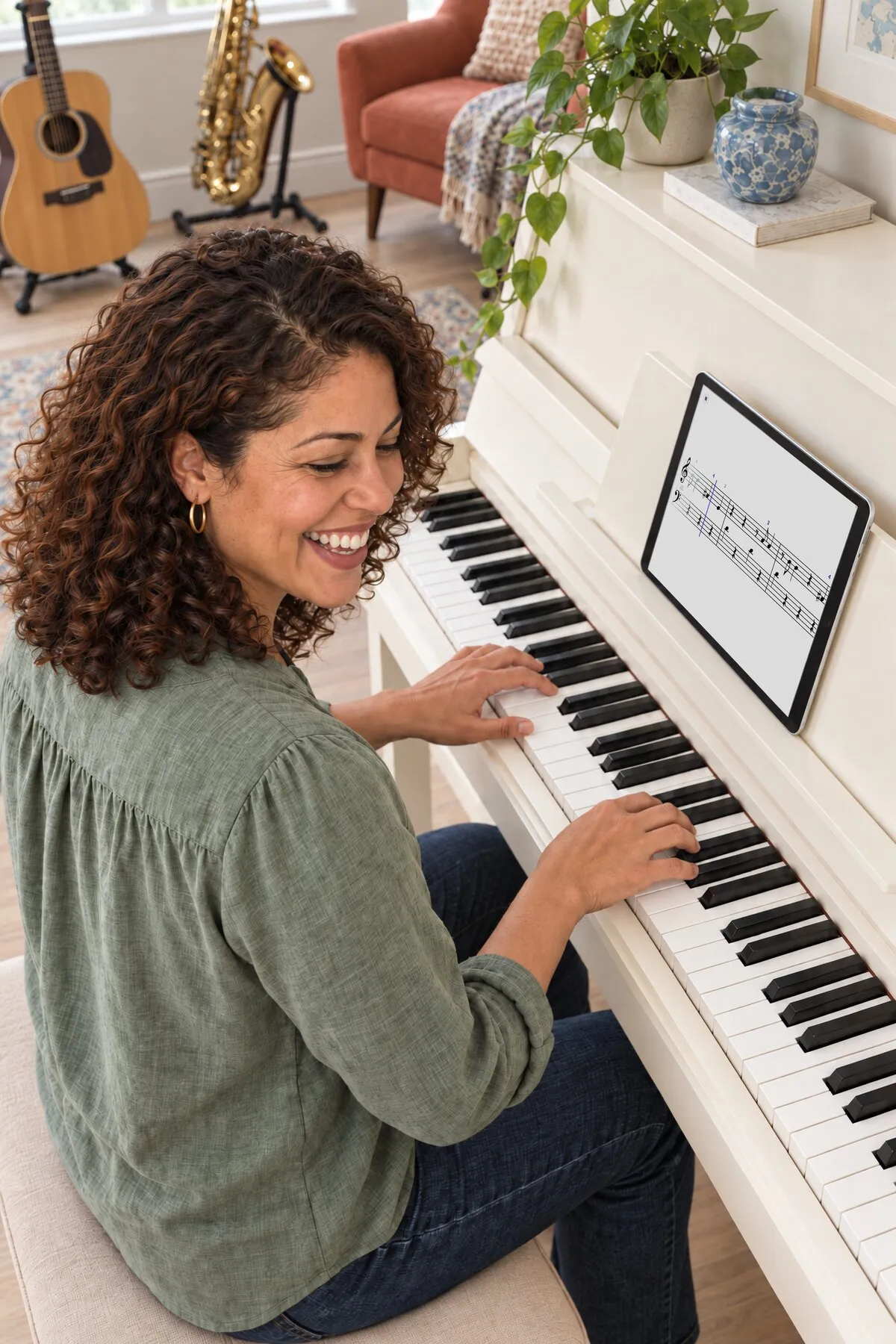
- Piano and keyboard. Press a key and a note sounds; two hands and two staves come later.
- Recorder and guitar. Blow gently or pluck a string, and a note is there. Covering holes fully and pressing strings cleanly come with a few weeks of regular practice.
- Saxophone and clarinet. A reed does part of the work, so a sound often comes on day one. A steady tone without squeaks follows as your air and your embouchure (the shape of lips and jaw around the mouthpiece) learn to work together.
- Flute. With no reed, you blow across an edge, and the first sound can take a few tries.
- Trumpet, trombone, horn, euphonium and tuba. On brass, the sound starts with your lips buzzing inside the mouthpiece. Some find the buzz right away, others need a few sessions.
- Violin and cello. An open string sounds with the first stroke of the bow; a clean, steady tone grows over weeks of regular bow practice.
Playing in tune
- Pitch built in. Piano keys give you the note, and so do guitar frets, as long as the guitar is tuned.
- Fingering plus breath. On saxophone, clarinet, flute and recorder, the fingering gives you the note, and your breath, plus your lips on all but the recorder, fine-tunes it.
- Lips and slide. On brass instruments, one valve combination or slide position holds several notes, and your lips choose which one sounds. The trombone's slide has no markings at all.
- No frets. On violin and cello, your finger sets the pitch to within millimeters, so your ear trains from day one.
Reading music
- One clef. Violin, flute, recorder, saxophone, clarinet and trumpet read treble clef; cello, trombone and tuba start in bass clef, and euphonium parts come in both.
- Two staves at once. Piano music combines a treble and a bass staff, which takes longer to read fluently.
- Written and sounding notes. On saxophone, clarinet, horn, the Bb trumpet and the euphonium in treble clef, you read and finger the written note, and it sounds at another pitch. Guitar sounds an octave below the written note, the soprano recorder an octave above.
Body, breath and neighbors
- Breath and holding. Wind players build steady breath over weeks; on flute, reed and brass instruments, they also train lip control. Cello and piano are played sitting, the violin rests on your collarbone, and the flute is held sideways.
- Volume at home. Brass and saxophone are usually louder than strings or a classical guitar, and your building and playing volume decide how much reaches next door. tonestro listens to the natural sound of your instrument through your device's microphone.
Is your instrument hard to learn?
- Is piano hard to learn?
- Is the violin hard to learn?
- Is the cello hard to learn?
- Is guitar hard to learn?
- Is the saxophone hard to learn?
- Is the flute hard to learn?
- Is the clarinet hard to learn?
- Is the trumpet hard to learn?
- Is the trombone hard to learn?
- Learn recorder
- Play the horn
- Play the euphonium
- Play the tuba
Questions about choosing
What is an easy instrument to learn as an adult?
There is no single answer. For a quick first sound, piano, recorder and guitar get you there fast; if you dream of an orchestra or a wind band, a string or wind instrument fits that dream. Above all, choose the one you want to hear yourself play.
Is guitar easier than piano?
Each is easy in its own way: a piano key sounds at a touch, while a few guitar chords let you accompany songs early, as soon as your first chord changes flow. Compare Is guitar hard to learn? and Is piano hard to learn?
Which instrument gets me playing quickly?
Any of them: tonestro gets you to a first song in ten minutes, with one or two notes inside a real song and a band around you. After that, regular practice sets your pace more than the instrument does.
Which instrument is quiet enough for an apartment?
A classical guitar sounds soft, and a digital piano can play quietly through its speakers, as long as your iPhone or iPad still picks it up clearly. Violin and cello are louder, brass and saxophone louder still.
Does tonestro teach every instrument the same way?
Piano, violin, cello, guitar, saxophone, flute, clarinet, recorder, trumpet and trombone have step-by-step courses made by music teachers. Horn, euphonium and tuba come with play-along songs and a theory course.
Updated: