
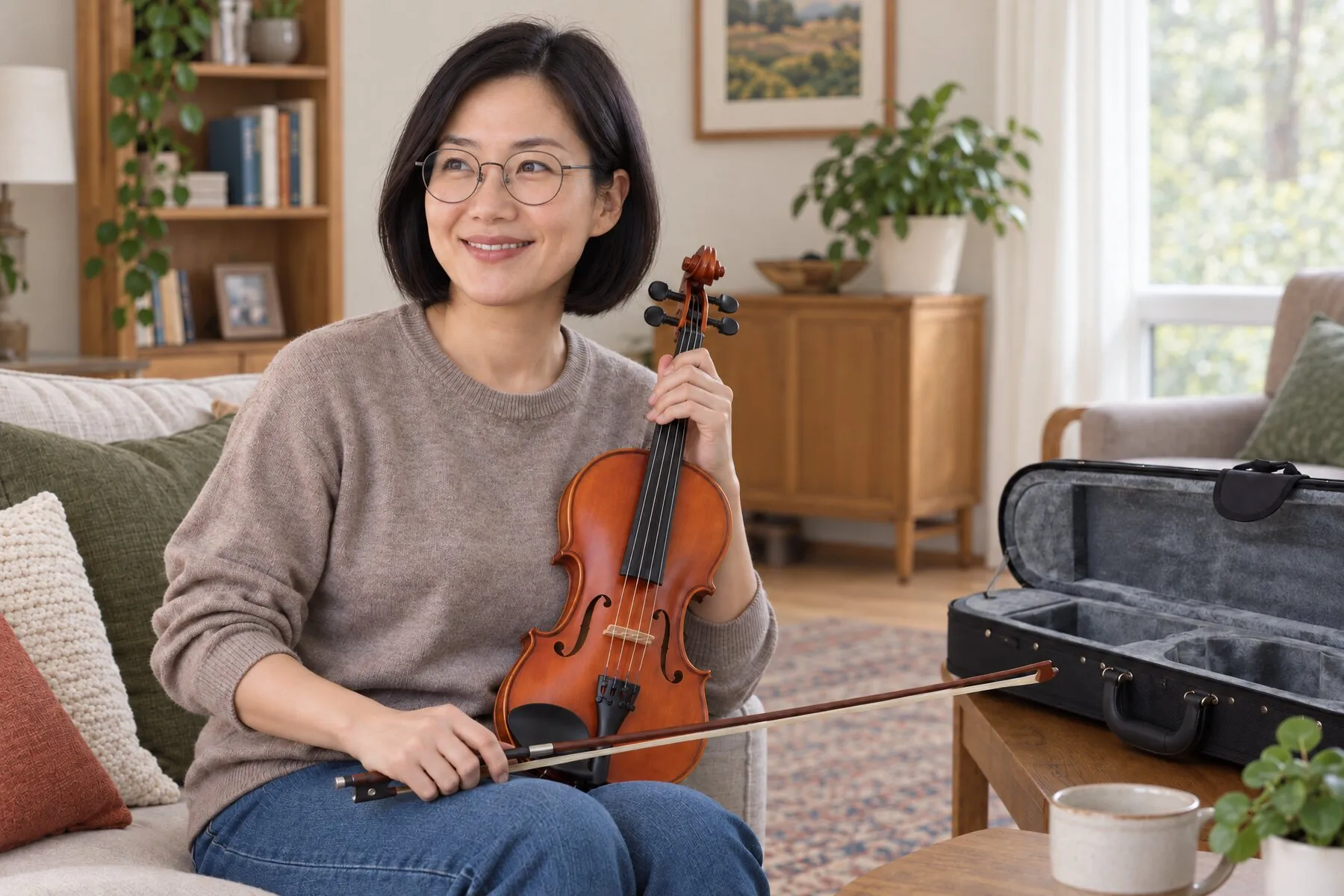
The short answer
- First note
- Day one: you bow an open string with a rosined bow.
- First song
- In ten minutes, with one or two notes in a real song with a band.
- A common hurdle
- Playing in tune on a fingerboard without frets.
- What helps
- Slow practice and feedback on every note.
Three real hurdles, and how you get past them
- Playing in tune
The fingerboard has no frets and no markings. A few millimeters decide whether a note is in tune, sharp or flat.
What helps: Play slowly and pay attention to each note. tonestro shows you right away whether you hit the pitch. At first, small tapes on the fingerboard can guide your fingers.
- A clean tone with the bow
At first the bow scratches, whistles or wanders toward the fingerboard. The tone depends on how fast the bow moves, how much weight it carries and where it meets the string.
What helps: Practice long, slow strokes on the open strings for a few minutes a day. Keep your arm flexible and match the weight you transfer through the bow to its speed and contact point. tonestro gives you feedback on pitch and rhythm; film yourself now and then to check the bow.
- Two hands, two jobs
Your left hand finds the notes while your right hand shapes tone and rhythm. Placing a finger exactly with the bow change takes coordination.
What helps: Separate the tasks first: practice bowing on open strings, then place your left fingers while plucking with your right hand. Then put both together slowly, at 60 percent speed if needed.
Easier than you think
- Four strings in fifths. The open strings sound G3, D4, A4 and E5. A finger pattern carries over to the next string a fifth higher, although a key can ask for a different pattern there.
- One hand position for a long time. Beginners stay in first position, near the scroll, and a great deal of music fits into that space.
- One clef, no transposing. Violin music uses only the treble clef and sounds exactly as written, so the note you read is the note you hear.
Easy songs to start with
A few of the 62 easy songs tonestro has for violin:
- Hot Cross Buns
- Korobeiniki (Tetris Theme)
- All for Me Grog
- Joshua Fit the Battle of Jericho
- Für Elise
- I Guess What I'm Trying to Say
Questions about the difficulty
Is the violin harder than the guitar or the piano?
Each is hard in its own way. Guitar frets and piano keys give you fixed notes. On the violin, you find the pitch of fingered notes without frets, which adds a challenge alongside learning to control the bow.
Why does my violin sound scratchy?
Scratching often means bow speed, pressure and contact point need adjusting, so check all three together. Add rosin only if needed, because too much can also cause scratching. Touching a neighboring string by accident adds an unwanted note.
Do I need a good ear to play the violin?
No, hearing pitch is a skill that grows while you play. tonestro marks each note as in tune or not. Over time, your ear starts to catch it on its own.
Is the violin too hard to teach yourself?
It works with small steps, feedback on your notes and a mirror or video for your bow. Read how to teach yourself the violin for a weekly plan.
Updated: