
Your start at a glance
- You need
- Violin, bow, rosin and tonestro on an iPhone, iPad or Android phone (iOS 15 or later; Android 8 or later with at least 4 GB of memory).
- First sound
- An open string, bowed in the middle of the bow.
- First song
- After ten minutes: one or two notes of yours, inside a real song with a band.
- First fingers
- B4, C#5 and D5 on the A string.
Your plan for the first week
- Day 1: ready the bow, find the hold
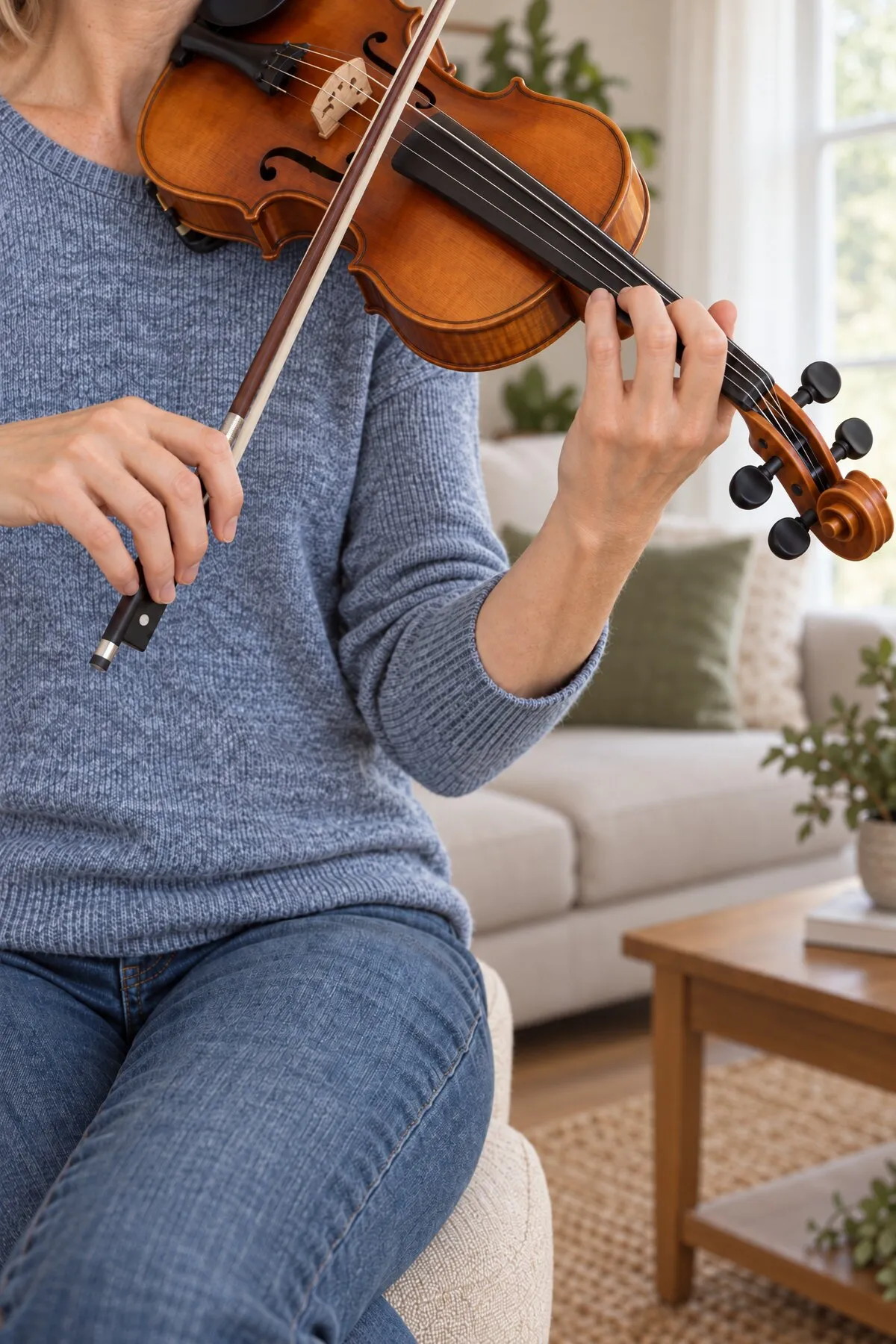
Tighten the bow until about a pencil's width of space shows between hair and stick, and rub rosin along the hair; loosen it again after practice. Rest the violin on your left collarbone and let your jaw settle on the chinrest without clamping. Keep the scroll from sinking toward the floor, then play your first song with one or two notes.
- Days 2 and 3: the bow hold
Bend your thumb and let its tip touch the stick at the frog, opposite your middle finger; your little finger stands curved on top of the stick. Then draw slow strokes on the open D and A strings in the middle of the bow.
- Days 4 and 5: your first fingers
For B4, place your first finger a whole step above the open A. Your second finger plays C#5, and your third, close beside it, plays D5. After every note, the app tells you whether your finger landed in tune.
- Days 6 and 7: a whole song
Pick an easy song that needs only open strings, such as Hot Cross Buns on D4 and A4, and play it at 60 percent speed. It is in 4/4, so count four steady beats per bar while your bow changes direction. Stay with any step until it feels secure.
Beginner mistakes, and how to fix them
- A sinking scroll
When your left arm gets tired, the scroll drops toward the floor. The violin tilts, and the bow slides toward the fingerboard.
What helps: Keep the violin roughly level and let collarbone, jaw and a light left hand share its weight, without squeezing or raising your shoulder.
- A collapsed left wrist
Many beginners rest the palm against the neck. The fingers then lie flat, touch neighboring strings and can't reach their notes.
What helps: Keep your wrist straight and leave a little space between palm and neck, so your fingers arch and land on their tips. Check your wrist in a mirror, and let tonestro tell you whether each note is in tune.
- Too little bow
Short, careful strokes with little weight feel safer, but the sound then often stays thin and small.
What helps: Start in the middle of the bow, keep it parallel to the bridge and let the weight of your arm sink into the string. Then let each stroke grow a little longer, counting two or four steady beats per stroke.
Easy songs for your first weeks
These easy versions need only the notes of open strings. All are among the 62 easy violin songs in tonestro:
- Hot Cross Buns
- Old MacDonald Had a Farm
- By the Schoolyard
- All for Me Grog
- Spring - La Primavera (The Four Seasons)
- Korobeiniki (Tetris Theme)
Beginner questions
What do the numbers above violin notes mean?
They tell you which finger to use: 1 is your index finger, 2 the middle, 3 the ring and 4 the little finger. A 0 stands for the open string.
Which strings do violin beginners start on?
Often the D and A strings in the middle: your bow arm sits comfortably there, and many first songs get by with these two. What follows after week one: How long does it take to learn the violin?
Where are the open strings on the staff?
In the treble clef, the open G string (G3) hangs below two ledger lines. D4 sits just below the staff, A4 in the second space and E5 in the top space.
What do the signs for down-bow and up-bow look like?
Down-bow, from frog to tip, looks like a small square bracket open at the bottom. Up-bow, from tip to frog, is a V. Where no sign is shown, a bar often starts with a down-bow.
Updated: