
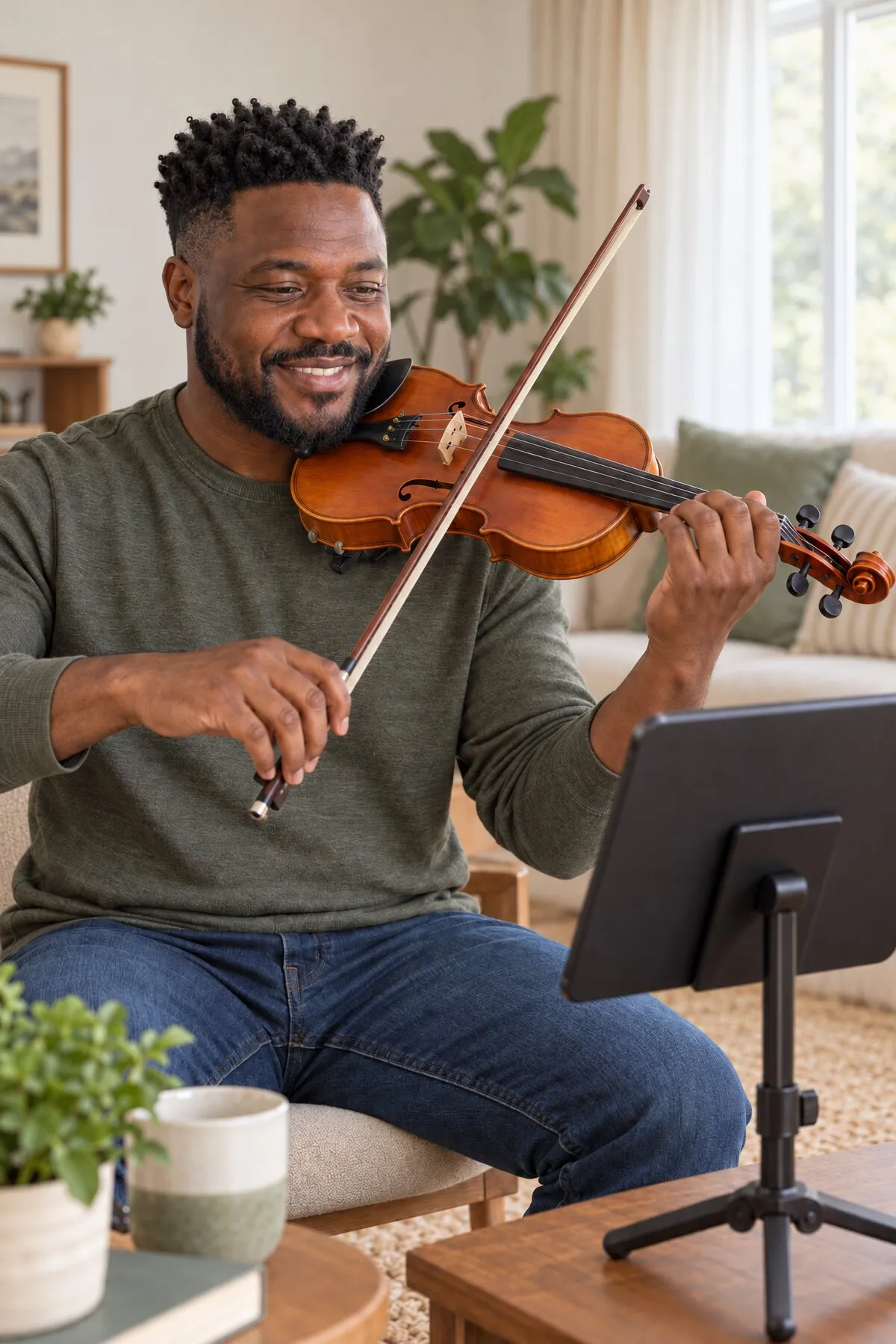
What you can do on your own
- Practice on your own schedule. Early morning, lunch break or late evening: no appointments and no travel, just your violin and a few free minutes.
- Find the right spot for each finger. Feedback on every note tells you when one is out of tune, so you can adjust your finger on the next try.
- Learn with a plan. Courses made by music teachers give you a clear next step, and the song library has music you actually want to play.
Three typical self-study mistakes on the violin
- Skipping the tuning
In lessons, a teacher often tunes the violin for you. On your own, it is easy to play on strings that have drifted. Your usual finger positions then no longer fit, and open strings sound off.
What helps: Tune all four strings before every session. With a little routine, it takes about a minute.
- Rushing past the bow
Melodies are more fun than open strings, so bow practice gets skipped. A bow that drifts makes the contact point harder to control and the tone less even.
What helps: Keep two minutes of long open-string strokes in every session, and check in a mirror that the bow stays parallel to the bridge.
- Letting tension creep in
With nobody watching, a raised shoulder, a tight jaw or a squeezing thumb can go unnoticed for weeks.
What helps: Check yourself at the start of each session: shoulders down, jaw loose, left thumb soft. If anything aches, stop and shake out your arms.
Your practice week
- Monday: a new step
Take the next step in your course: one new note, rhythm or bow stroke.
- Tuesday: repeat slowly
Go over it again at a slower tempo, and speed up only when it feels comfortable and steady.
- Wednesday and Thursday: songs
Use the notes you know in songs from the library, and save a few minutes for a slow scale.
- Friday: a song you love
Play it from start to finish. Keep a steady pulse, then practice the difficult bars on their own.
- Weekend: time off
Two days off are fine. After every session, loosen the bow hair and wipe rosin dust off the strings, the violin and the bow stick with a soft, dry cloth; leave the hair itself alone.
Songs for practicing on your own
The song library has 62 easy violin songs, including these:
- By the Schoolyard
- All for Me Grog
- Down to the River to Pray
- I Guess What I'm Trying to Say
- Bella Ciao
- Für Elise
Questions about self-study
Can you really teach yourself the violin?
Yes, many adults learn on their own with regular practice, honest feedback on their notes and an eye on bow and posture. More in Learning without a teacher.
How do I know if I am playing in tune?
tonestro hears every note through the phone or tablet microphone and tells you at once whether it was in tune and in time. How it works: How does tonestro hear me play?
How do I tune my violin on my own?
Use a tuner and tune to A4, D4, G3 and E5, checking the octave as well as the note name. For bigger changes, turn the peg gently while pressing it into the pegbox. For small ones, use the fine tuners if your violin has them.
Should I take violin lessons or learn with an app?
That depends on your everyday life. With tonestro, you practice on your own schedule and get feedback on pitch and rhythm; a violin teacher can also assess your posture, bow hold and movements. A comparison: Music lessons or an app?
Updated: