
Quick Answer
Bass clef notes show pitches commonly used for the lower parts of piano music. Start with low C, one octave below middle C: it sits in the second space from the bottom of the bass staff. Put your left little finger on that C and play C-D-E-F-G with fingers 5-4-3-2-1. For reference, the bass-clef lines from bottom to top are G-B-D-F-A, and the spaces are A-C-E-G. Learn the first five-note pattern slowly, connecting each written note to its piano key.
What Are Bass Clef Notes On Piano?
The bass clef is the curved symbol with two dots at the beginning of a staff. It tells you how to read the pitches on that staff’s five lines and four spaces.
Piano music often places a treble staff above a bass staff. Beginner arrangements commonly give the lower bass-clef part to the left hand. A clef identifies pitches, however; either hand can play notes written in either clef when the music calls for it.
If you already know the keyboard’s note names, you have a useful head start. The task here is to connect those familiar keys to their written positions.
For the repeating keyboard pattern, see Piano Notes for Beginners. In this lesson, we will begin reading from one specific C.
Find Low C One Octave Below Middle C
First, locate middle C near the centre of your keyboard. C is the white key immediately to the left of a group of two black keys.
Now find the next C to its left. That is the low C used throughout this lesson.
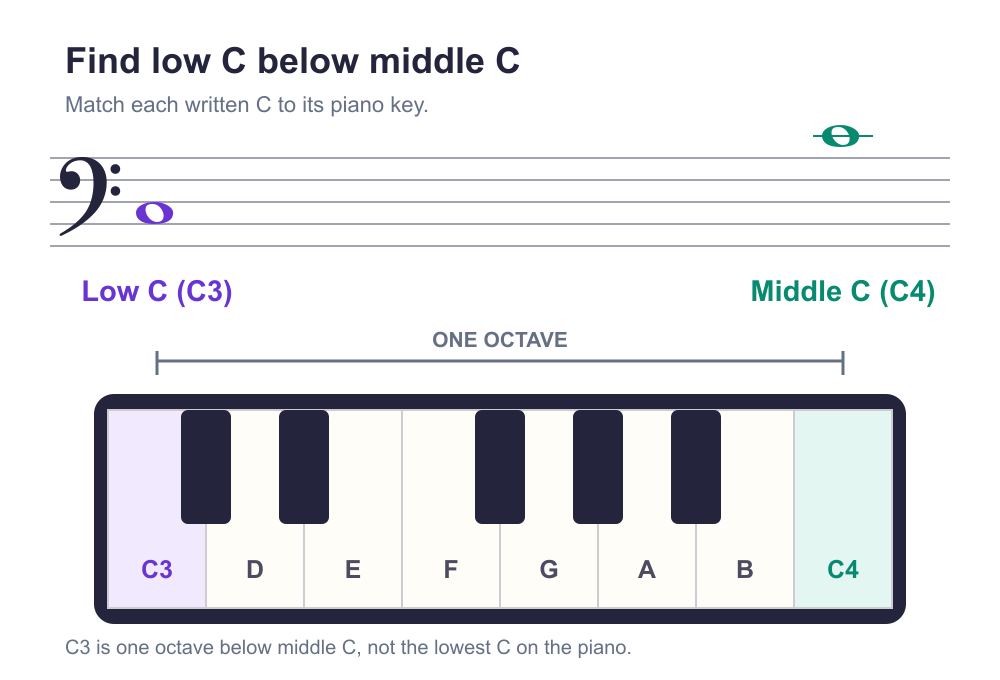
The distance from one C to the next C is an octave. The two notes share a letter name, but the C to the left sounds lower.
You may see these octave labels:
- Low C in this lesson: C3. One octave below middle C.
- Middle C: C4. Our reference point near the centre of the keyboard.
Here, low C means this particular C3, rather than the lowest C on the whole instrument. If finding middle C is still uncertain, follow What Is Middle C on Piano? first.
Watch: Bass Clef, Octaves, And Left-Hand C Position
This short video from tonestro’s in-app piano courses introduces the bass clef, shows the octave between neighbouring Cs, and demonstrates where to place your left hand. Watch once, then pause at the hand-position example and try it on your own keyboard.
Video Transcript
This is the bass clef. It is used for lower notes, which are usually played with the left hand.
Now look at the C notes on your keyboard. Every C is the white key immediately to the left of a group of two black keys. The distance from one C to the next is called an octave.
You already know middle C, which is near the centre of the keyboard, and usually played with the right hand. The next C to its left is one octave lower. This lower C is the starting point for your left-hand position.
Place your left pinky on this C and let the other fingers rest naturally on the neighbouring white keys.
Read C-D-E-F-G In The Bass Clef
Find C3 in the second space from the bottom of the bass staff. Count spaces upward between the lines; do not count the area below the staff as a space inside it.
From that C, move upward through the musical alphabet. Each step to the next letter moves from a space to a line or from a line to a space.
- C3: second space from the bottom.
- D3: middle line.
- E3: third space from the bottom.
- F3: fourth line from the bottom, or second line from the top.
- G3: top space.
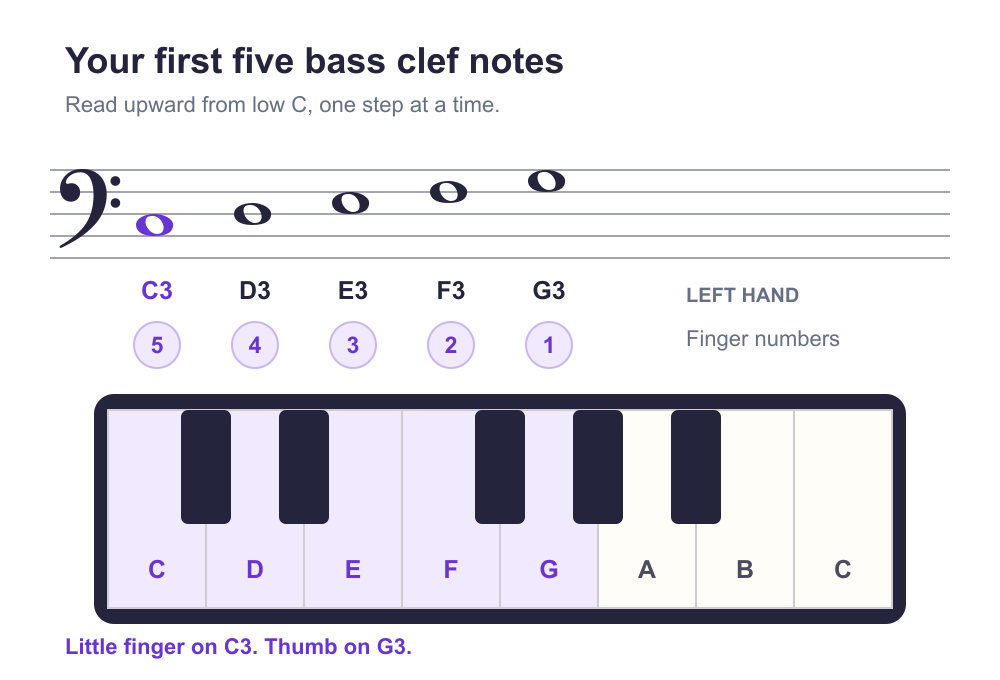
Say the letters while looking at the written notes, then find their keys. The same upward movement has two forms: higher on the staff and farther right on the keyboard.
The dots of the bass-clef symbol sit on either side of the F line. That is why it is also called the F clef. You can use F as another landmark once the first C-position notes feel familiar.
Put Your Left Hand In C Position
Rest one finger over each of the five white keys:
- Little finger 5 on C3.
- Ring finger 4 on D3.
- Middle finger 3 on E3.
- Index finger 2 on F3.
- Thumb 1 on G3.
Play C-D-E-F-G slowly using 5-4-3-2-1. Coming back down, play G-F-E-D-C using 1-2-3-4-5.
Keep the fingers comfortably curved and the wrist flexible. Let the thumb rest naturally on its side. The little finger starts on low C; the thumb starts on G.
This is a useful first position for these exercises. Left-hand piano notes will not always use these finger numbers: other melodies and positions need different fingering.
Three Easy Bass Clef Reading Exercises
Use the C position above and practise with the left hand alone. Each score contains two measures of 4/4, with four beats per measure.
Purple numbers above the notes are finger numbers. Green numbers underneath are beat counts. The counts continue while you hold a long note; they do not mean you must press the key again.
Before playing, find the first written C and point to its key. Then look at whether the next notes repeat, step, or skip.
Exercise 1: Read Three Neighbouring Notes
Play C-D-E-D, then finish on C. Use fingers 5-4-3-4, then 5.
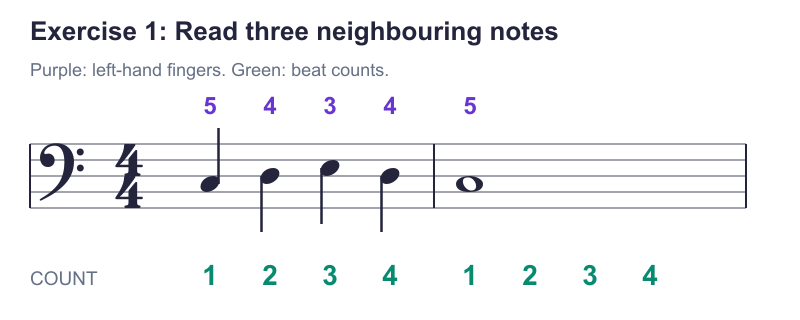
The first four notes each last one beat. The final C lasts four beats. Keep counting 1-2-3-4 while holding it, then release at the beginning of the next measure.
This exercise connects the second space, middle line, and third space without moving the hand.
Exercise 2: Notice The Skips
Play C-E-G-E, then finish on C. Use fingers 5-3-1-3, then 5.
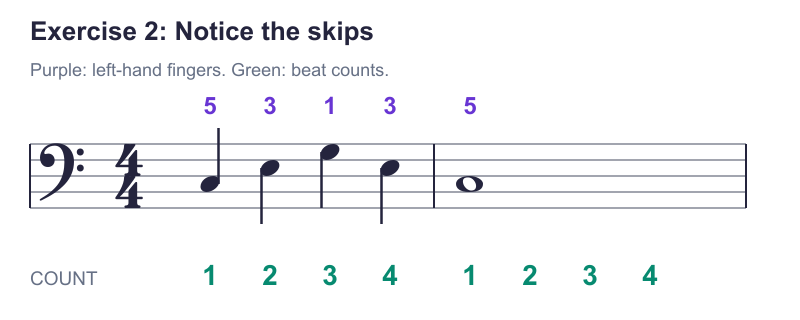
The first four notes last one beat each; hold the final C for four beats. C, E, and G are all written in spaces. Moving from one space to the next skips over the line between them, just as the fingers skip a white key.
Check the note names after noticing the shape. This helps you read a pattern rather than calculate every note from scratch.
Exercise 3: Use All Five Notes
Play C-D-E-F, then G-C. Use fingers 5-4-3-2, then 1-5.
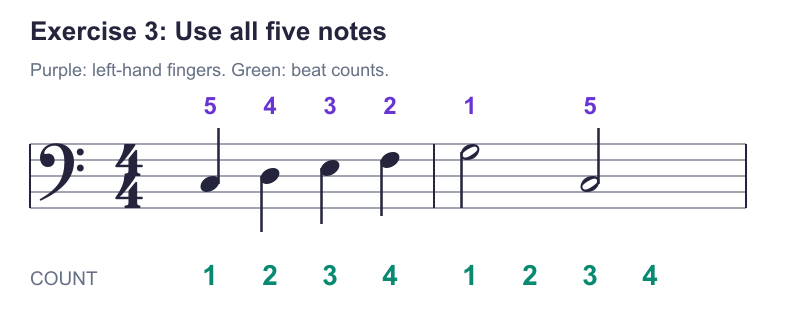
Play one note per beat in the first measure. In the second measure, play G on 1 and hold through 2, then C on 3 and hold through 4.
Keep the little finger ready over C while the thumb plays G. For help counting long notes, review Piano Rhythm for Beginners.
Bass Clef Notes Chart: Lines And Spaces
The full staff uses a wider range than the five-note position. Use this chart to check a note when needed, then return to the small reading exercises.
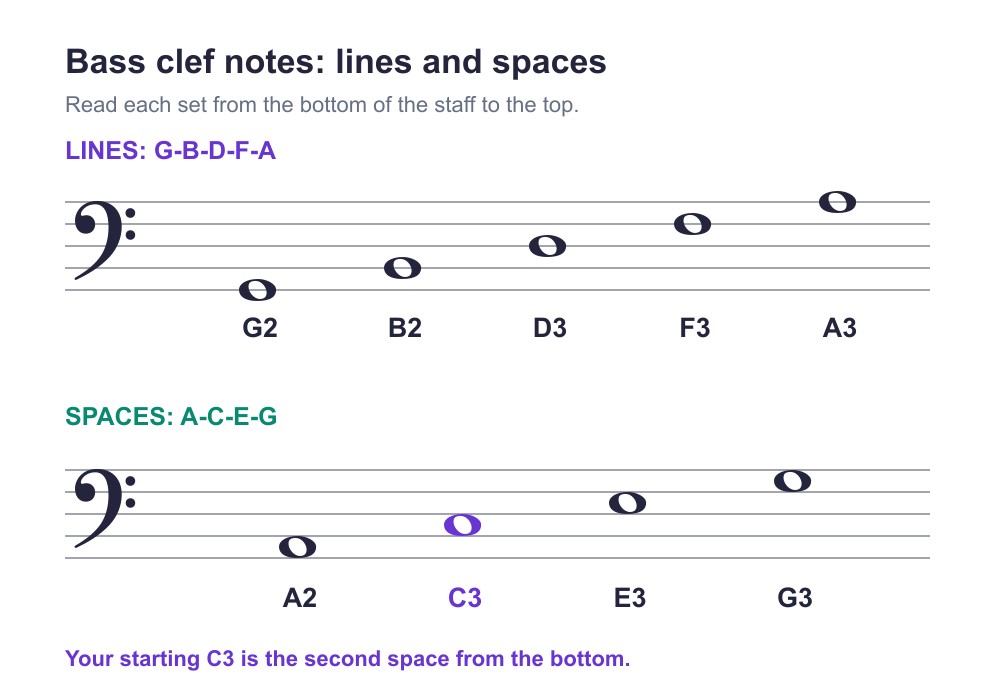
Bass Clef Line Notes
From the bottom line to the top line, the letters are:
G-B-D-F-A
The middle line is D. The line between the clef’s two dots is F.
Bass Clef Space Notes
From the bottom space to the top space, the letters are:
A-C-E-G
A memory phrase such as All Cows Eat Grass can help you check the spaces. Low C is the second of those four spaces.
You can use a memory phrase, a familiar landmark, or the distance from a note you already know. Keep connecting the answer to a real piano key so naming the note becomes useful for playing.
Where Is Middle C In Bass Clef?
Middle C, C4, sits on the first ledger line above the bass staff. A ledger line is a short extra line used for a note outside the five staff lines.
Compare the two Cs in the first diagram:
- C3: inside the bass staff, in the second space from the bottom.
- C4: above the bass staff, on its first upper ledger line.
They have the same letter name but are one octave apart. Check both the letter and the written height before choosing a key.
You can also see middle C written on the first ledger line below the treble staff. It is the same piano key in both cases. How to Read Sheet Music for Piano Beginners explains how the two staves work together.
Common Beginner Confusions
Mixing Up Low C And Middle C
Find middle C first, then move to the next C on the left. In this lesson, the left little finger belongs on that lower C.
Counting The Spaces From The Top
The chart lists lines and spaces from bottom to top. Start at the lowest line or the lowest space inside the staff when checking the sequence.
Using Treble-Clef Note Names On The Bass Staff
The same staff position has different note names in different clefs. Check the clef before reading. The bass staff’s middle line is D, while the treble staff’s middle line is B.
Confusing A Finger Number With A Note Name
Finger 5 is the left little finger, not a note called five. It plays C in this position, but can play other notes when the hand moves.
Looking Only At The Keyboard
Find the starting position, then try to look back at the score for each short pattern. Glance down when needed and return to the page.
Adding Both Hands Too Soon
Give the left hand time to read and move on its own. When these exercises feel steady, How to Play Piano With Both Hands offers a gradual next step.
A Five-Minute Bass Clef Practice Routine
- Minute 1: find middle C, then the C one octave below it.
- Minute 2: say and play C-D-E-F-G with left-hand fingers 5-4-3-2-1.
- Minute 3: read exercise 1, looking at the staff before each note.
- Minute 4: try exercise 2 or 3 slowly.
- Minute 5: cover any written letter prompts and read one familiar pattern again.
Repeat one exercise for the whole session if that is the right challenge. For children, start with finding C and reading three notes. Adults can use the same small task while keeping the rhythm steady and the hand relaxed.
Place this inside the skill-focus part of the 15-Minute Piano Practice Routine for Beginners.
Practise Bass Clef Reading With tonestro
The video in this article comes from the tonestro app’s piano courses. Use it to review the octave and starting position, then continue with guided lessons and short exercises that connect written notes to the keyboard.
Pay attention to feedback on both notes and rhythm. When a passage becomes uncertain, practise a few left-hand notes separately, then return to the lesson. Follow the fingering shown in the selected exercise; C position is the starting point for this article, not a fixed position for every piece.
Related Reading
- Piano Notes for Beginners
- What Is Middle C on Piano?
- How to Read Sheet Music for Piano Beginners
- Piano Rhythm for Beginners
- How to Play Piano With Both Hands
- 15-Minute Piano Practice Routine for Beginners
FAQ
What are the bass clef notes from bottom to top?
The lines are G-B-D-F-A, and the spaces are A-C-E-G. Read each sequence from bottom to top. Start with a few notes and connect them to their piano keys before trying to memorise the whole chart.
Where is low C in the bass clef?
The low C used in this lesson is C3, one octave below middle C. It sits in the second space from the bottom of the bass staff.
Where is middle C in bass clef?
Middle C, C4, is on the first ledger line above the bass staff. It is one octave above the C3 used for the left-hand C position in this lesson.
Which finger goes on C in left-hand C position?
Put the left little finger, finger 5, on low C. The other fingers rest on D, E, F, and G, using 4, 3, 2, and 1 respectively.
Does the bass clef always mean left hand?
No. It identifies the pitches on the staff. Beginner piano arrangements often assign bass-clef notes to the left hand, but either hand can play in either clef.
Why is the bass clef also called the F clef?
Its two dots sit on either side of the F line, the fourth line from the bottom. This identifies the F below middle C.
How can I learn bass clef notes faster?
Choose a reliable starting note, such as low C, then read nearby steps and skips. Play short patterns while looking at the score, check them against the keyboard, and practise briefly on most days.
Last updated