
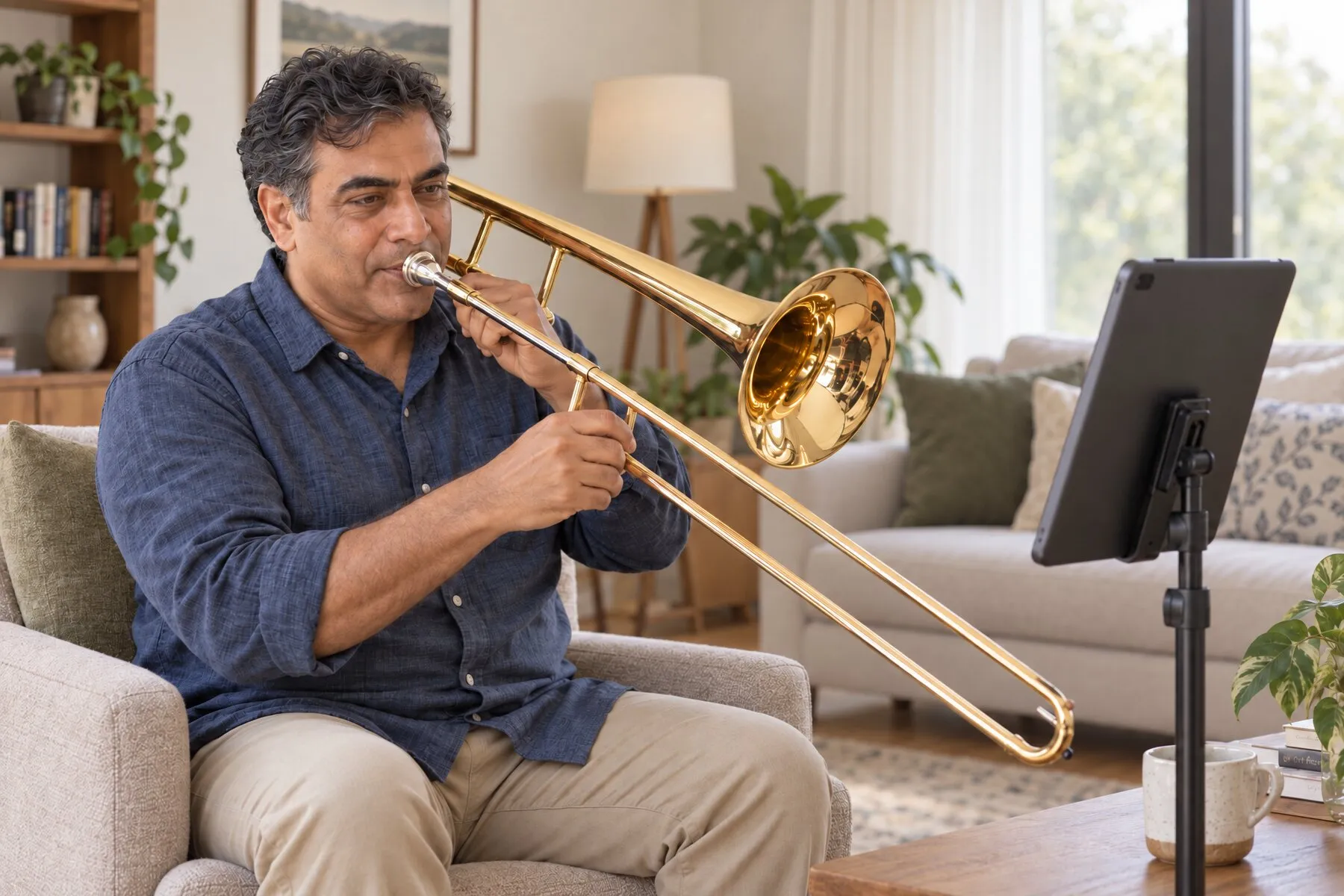
What you can do on your own
- Learn the positions. The slide-position chart in the app shows where each note sits, from 1st to 7th position. Your arm learns the rest through practice.
- Build your tone. Long tones, slow lip slurs and clean tongued starts need nothing but you, your trombone and a few minutes.
- Check pitch and rhythm. After every note, tonestro shows whether you were in tune and in time. Both are hard to judge while you are busy playing.
Three typical self-study mistakes
- Gripping the slide
Many self-taught players hold the slide like a handlebar. The arm tenses up, and the slide arrives late and off target.
What helps: Let your left hand carry the weight; your right thumb and two fingers guide the slide loosely, from a relaxed wrist. A short video of yourself shows whether your hands stay relaxed.
- Smearing between notes
When two notes lie on the same partial, moving the slide between them can cause a smear, a glissando the music rarely asks for.
What helps: Keep the air flowing and coordinate a quick slide change with a soft tongue on the new note.
- Pressing the mouthpiece
When high notes will not come, it is tempting to push the mouthpiece harder against your lips. That tires them fast and thins your tone.
What helps: Avoid extra pressure and build higher notes gradually, with air and embouchure working together and frequent rests. Check your embouchure in a mirror, and let tonestro show you whether each note comes out in tune.
Your practice week
- Tone first
A few long tones in 1st position, pausing after each. Once F3 and Bb3 both speak easily on their own, practice slow lip slurs between them.
- Positions
Play the first five notes of the Bb Major Scale slowly, Bb2 to F3, in positions 1, 6, 4, 3 and 1.
- One new song a week
Learn it bar by bar at 60% speed. Move up to 80% once it runs steadily, and to full tempo once 80% feels comfortable.
- Rest days
Take a day off whenever your lips need to recover.
- With the band
Once the song runs steadily, play it with the band and see which notes were not yet in tune.
Songs to practice on your own
Begin with these, then work through all 51 easy songs:
- Andean Melody
- Cute Horror Song
- Where Did You Sleep Last Night
- Hot Cross Buns
- She'll Be Coming Round the Mountain
- Symphony No. 40
- House Of The Rising Sun
Self-study questions
Can you really teach yourself trombone?
Yes. Alongside regular practice and feedback on pitch and rhythm, check your posture and embouchure yourself in a mirror or on video. More on this in Learning without a teacher.
How do I know if my slide position is right?
Your ear tells you first, and tonestro shows you at once whether a note was in tune. If it was clearly wrong, check that you hit the intended partial; for small corrections, move the slide out when a note is sharp and in when it is flat.
What do I need to teach myself trombone?
Your trombone, slide care, a holder for your phone or tablet and a few minutes on most days. The full list is in What do I need?
Can I learn trombone with an app?
Yes. tonestro has two courses made by music teachers and a song library, and it hears every note through the microphone of your phone or tablet. Here is how tonestro hears you play.
Updated: