
Your start at a glance
- You need
- Cello with bow and rosin, plus tonestro on an iPhone, iPad or Android phone (iOS 15 or later; Android 8 or later with at least 4 GB of memory).
- First sound
- An open string, bowed midway between the bridge and the end of the fingerboard.
- First song
- Ten minutes, one or two notes, a real song with a band.
- First notes
- E3, F#3 and G3 on the D string.
Your plan for the first week
- Day 1: find your height
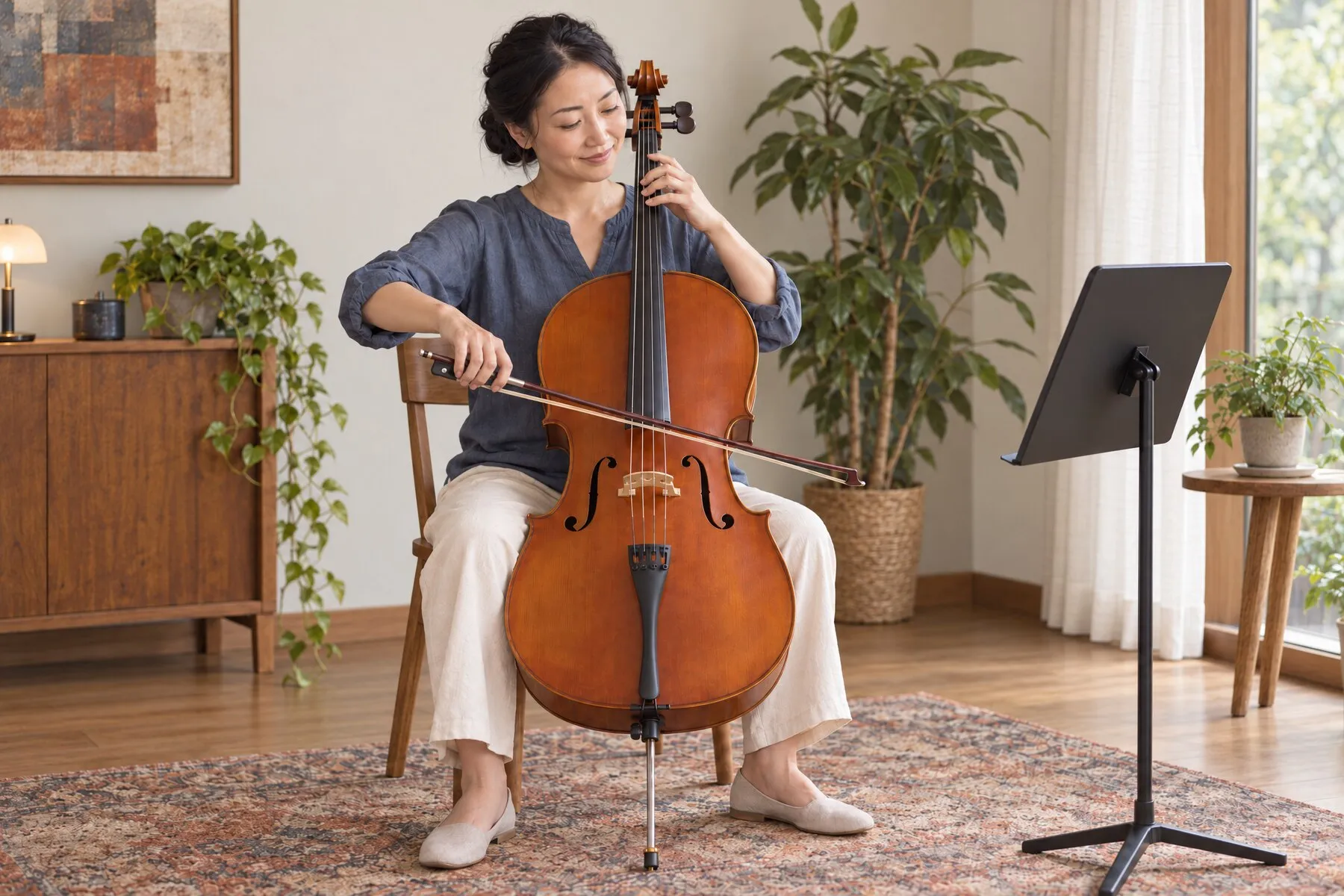
Set the endpin so the C-string peg ends up near your left ear and your knees touch the sides of the cello lightly. Then join your first song with one or two notes.
- Days 2 and 3: open strings in rhythm
Play quarter notes in 4/4 on the open D and A strings, one bow stroke per note, counting four beats per bar. Then do the same on the G and C strings.
- Days 4 and 5: the first pattern
On the D string, play E3 with your first finger, F#3 with your third and G3 with your fourth. In this closed first-position pattern, neighboring fingers sit a half step apart, so the whole step from E3 to F#3 reaches from finger 1 to finger 3.
- Days 6 and 7: a whole scale
Move the same pattern to the A string for B3, C#4 and D4. Together with the open D and A strings, that gives you the D Major Scale from D3 to D4. Give each step the days it needs; the order matters more than the dates.
Beginner mistakes, and how to fix them
- An endpin set too short
A cello that sits too low makes you bend forward, and your left hand has to reach down to the strings.
What helps: If you lean toward the strings, pull the endpin out a little further; if the cello pushes your shoulders up, push it back in a bit.
- Mixing up the finger patterns
Using your second finger where the third belongs makes the note a semitone too low, and the melody turns sour.
What helps: Before you play, check whether the next step from your first finger is a whole step (fingers 1 and 3) or a half step (fingers 1 and 2). tonestro marks a wrong note right away.
- A dropped left elbow
When the left elbow hangs down, the wrist bends and the fingers flatten instead of staying rounded over the string.
What helps: Let the elbow float out to the side, so your hand curves over the string like a loose C. A mirror shows you whether your elbow stays up.
Handy for week one
- Cello fingering chart: every note from C2 to Eb4
- Will I really play my first song in 10 minutes?
- Can I learn an instrument without a teacher?
Beginner questions
Where are the cello's open strings in bass clef?
C2 sits on the second ledger line below the staff, G2 on the bottom line, D3 on the middle line and A3 on the top line. The cello fingering chart shows the notes in between.
How do I know which string a note is on?
In first position, each string covers its open note and the notes up to a fourth above it, played with fingers 1 to 4. Higher notes move to the next string: in the D Major Scale, the open A string gives you A3 right after G3.
Why does my cello buzz?
Often a finger doesn't press the string all the way down, or it touches a neighboring string. If an open string buzzes too, a loose fine tuner or another loose part may be rattling; a string shop can find it.
What does "pizz." mean in cello music?
Pizzicato: you pluck the string with your right index finger instead of using the bow. When "arco" appears, you take the bow again.
Updated: