
At a glance
- Age
- Never too late, whether you are 40 or 70.
- Where
- At home, whenever it suits you.
- Practice
- About 15 to 20 minutes on most days.
- First song
- In ten minutes: one or two notes along with a real song and a band.
Why adults learn the cello well
- You sit comfortably. The cello stands on its endpin, you sit upright, and your arms move naturally. The floor carries most of the weight.
- You know what you want to play. Maybe it is a film melody or a piece from a concert. A goal like that carries you through the first weeks.
- Your cello size stays the same. Children move through several cello sizes and have to readjust their finger spacing each time. As an adult, you usually stay with one size, so the spacing you learn stays familiar. Higher positions bring narrower spacing later.
What you need to start
- Your cello, ready to play. If it has been stored for years, have a string shop check strings, bridge and bow hair.
- Rosin for the bow. Without it, the bow glides over the strings almost silently.
- A firm, flat chair that leaves your bow arm free, and a non-slip stop for the endpin on smooth floors.
- Your phone or tablet with tonestro: an iPhone or iPad with iOS 15 or later, or an Android phone with Android 8 or later and at least 4 GB of memory.
How it starts
- Sit and set up
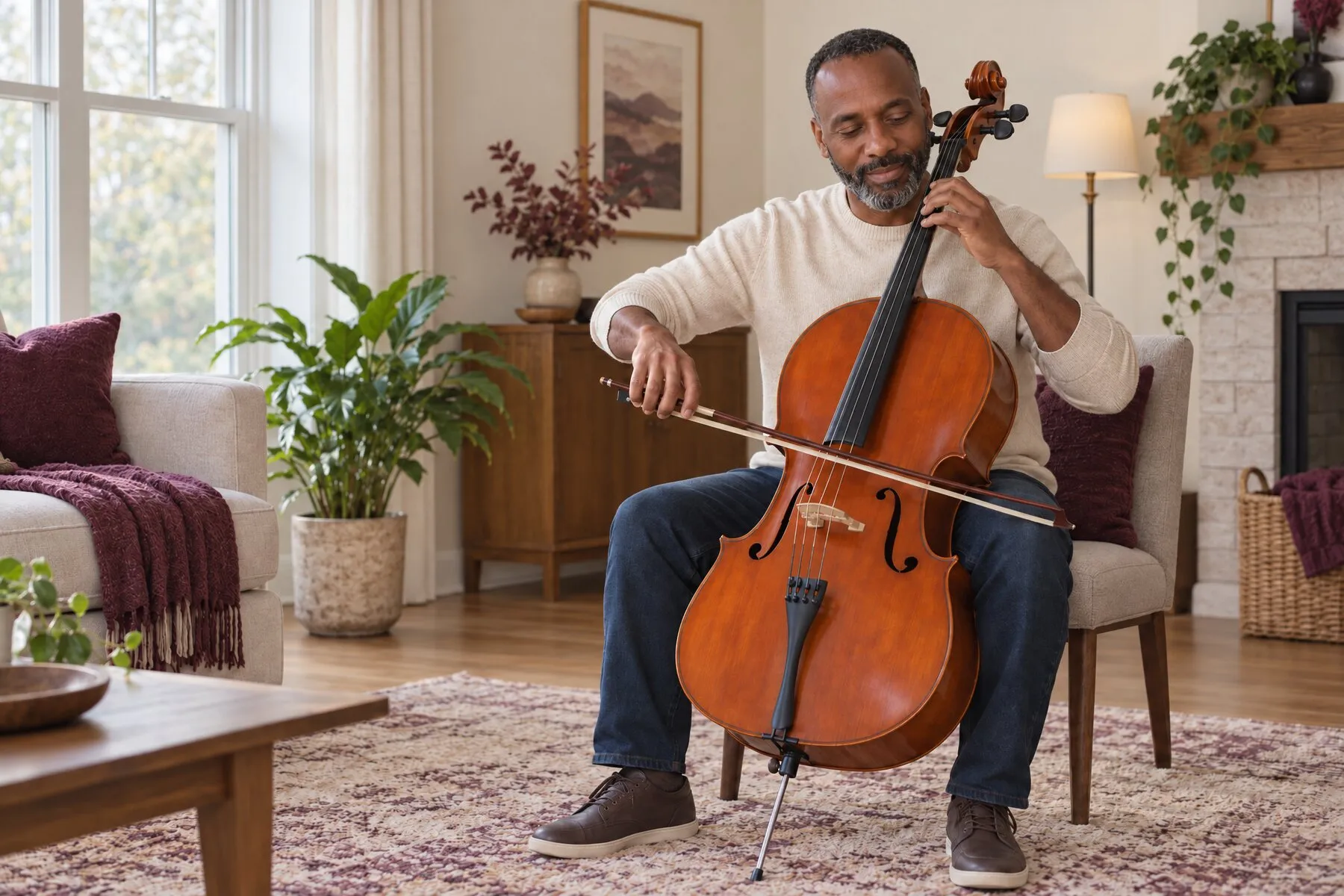
Pull out the endpin, sit on the front edge of the chair and let the upper edge of the cello rest against your chest. Tighten the bow hair, rub it with rosin and check all four strings with a tuner.
- Your first song
You play one or two notes along with a real song while a band plays with you. You'll manage that within about ten minutes.
- The left hand joins in
In closed first position, neighboring fingers play notes a semitone apart; extended positions use wider spacing. After every note, tonestro shows you whether it was in tune.
Look it up
- Cello fingering chart (C2 to Eb4)
- What do I need to practice with tonestro?
- Music lessons or an app: which is right for me?
Three tips for everyday practice
- Keep it within reach. A cello on a stand is quicker to grab than one in its case, so you tend to play more.
- Play for someone. A short piece for a friend or your family gives you a goal to work toward.
- Care takes one minute. After playing, loosen the bow hair and wipe the rosin dust off the strings with a soft cloth.
Questions adults ask
Am I too old to learn cello at 50 or 60?
No. Your ears, hands and patience keep learning at any age, and you set the pace. Rough guidelines for the first two years: How long does it take to learn cello?
What size cello does an adult need?
Most adults play the full size, 4/4. If you are petite or have small hands, try a 7/8 in a string shop as well.
Can I learn cello with no musical experience?
Yes. Your first song needs only one or two notes, and tonestro has two cello courses made by music teachers. Here is how your first song works.
I played cello as a child. Can I pick it up again?
Yes. Much often comes back quickly, usually the finger pattern and bass clef first. Start a little below where you stopped and give your fingertips a few weeks.
Do I need to read bass clef before I start?
No. You learn it note by note while you play, and cello music sounds as written. Higher passages later also use the tenor clef. If you have played the piano, you know bass clef from the left hand.
Updated: