
Your start at a glance
- You need
- Your trumpet with its mouthpiece, and tonestro running nearby.
- First notes
- Written E4, F4 and G4: valves 1-2, valve 1 and none.
- First song
- Ten minutes in: one or two notes with a band, in a real song.
- First goal
- Symphony No. 40 in its easy version: just those three notes.
Your plan for the first week
- Day 1: the hold
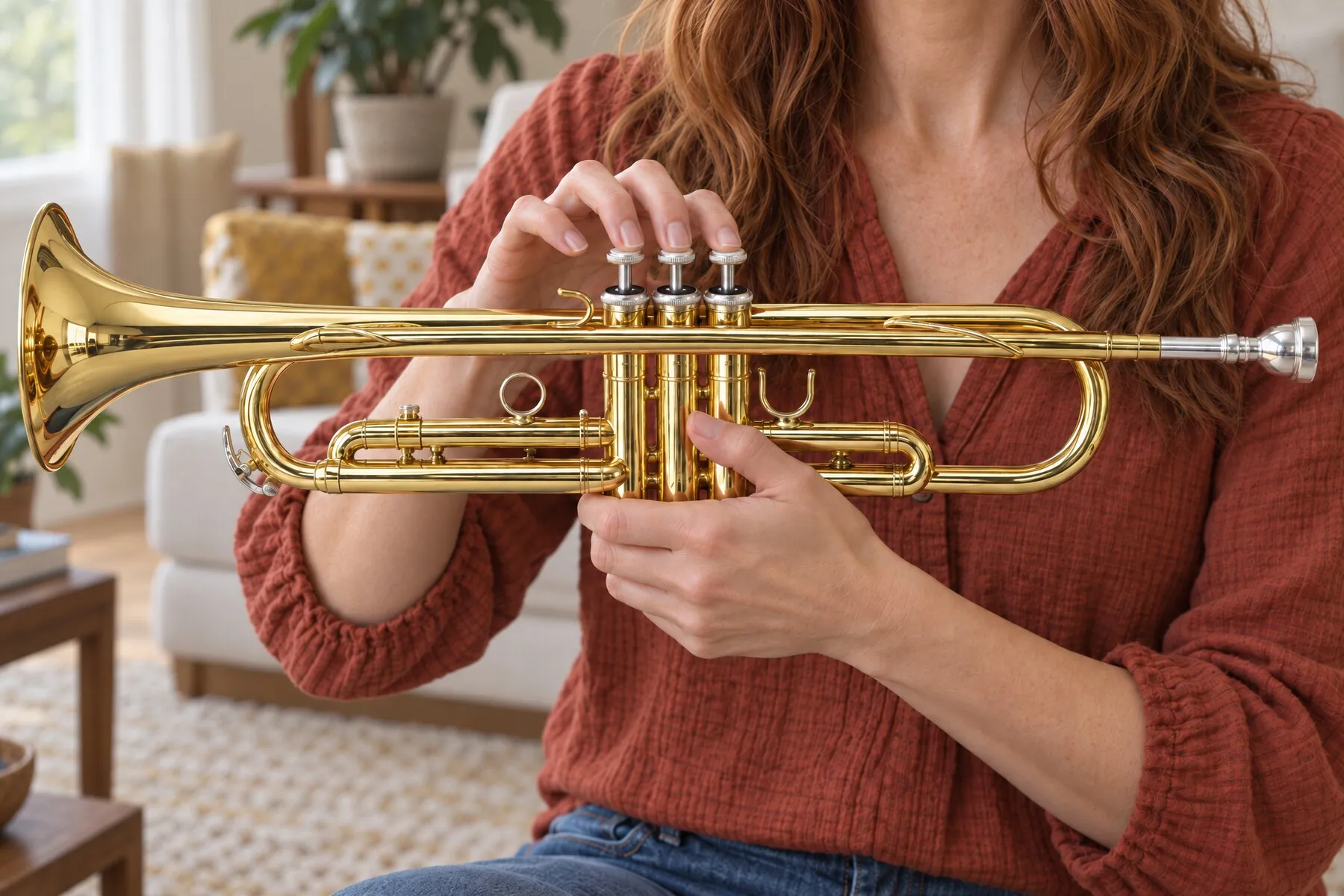
On a piston-valve trumpet, wrap your left hand around the valve casings and put your left ring finger in the ring of the third valve slide. Your right thumb goes under the leadpipe between the first and second valve; then you're ready for your first song. A rotary-valve trumpet is held differently, but its valve numbers are the same.
- Days 2 and 3: the mouthpiece
Place the mouthpiece in the middle of your lips, side to side; how high it sits varies a little from player to player. Keep the corners of your mouth firm and blow a steady stream of air so your lips buzz. With no valves pressed, the trumpet can play several notes: aim for written G4, hold it for four slow beats, and tonestro shows you whether G4 sounded.
- Days 4 and 5: two more notes
Press the first valve for written F4, and the first and second for E4. Push each valve all the way down, quickly, with your fingertips.
- Days 6 and 7: your first three-note song
Start slowly with Symphony No. 40 in its easy version; it uses only these three notes. Then try Hot Cross Buns: written C4, D4 and E4, played open, with 1-3 and with 1-2. Play in short stretches and rest your lips as much as you play; stay with a step until it feels secure.
Beginner mistakes, and how to fix them
- The little finger in the hook
Hooking your right little finger into the finger hook makes it easy to pull the trumpet against your lips.
What helps: Rest the little finger on top of the hook and leave the weight to your left hand. With less pressure, your lips can keep buzzing longer.
- Valves pressed halfway
A valve that is only half down sounds stuffy and unsteady, or the note doesn't speak at all.
What helps: Press straight down and all the way, with your fingers curved over the buttons. tonestro shows you at once whether each note sounded at the right pitch.
- The bell pointing at the floor
When your head drops and the bell points down, your neck tenses and the air stops flowing freely.
What helps: Sit or stand tall and keep the bell roughly level or slightly lowered; bring the trumpet to your lips, not your lips to the trumpet. A short video shows you how you hold it.
Songs for your first weeks
These need only a handful of notes, and all of them are on tonestro's list of 63 easy songs for trumpet in Bb:
- Symphony No. 40
- Hot Cross Buns
- Ode to Joy
- Happy Birthday
- Danse macabre
- Where Did You Sleep Last Night
Beginner questions
Which mouthpiece should a trumpet beginner use?
The standard mouthpiece that came with your trumpet will serve you well for the first months. Change it only once you know what you want to change.
How do I get the water out of my trumpet?
Press the water key on the main tuning slide and blow air through the trumpet without buzzing. Do it whenever the sound starts to gurgle.
Does a trumpet need tuning?
Yes, a little: the main tuning slide sets the overall pitch. Pull it out slightly to sound lower or push it in to sound higher, and check written C4 with a tuner: on a Bb trumpet, it shows Bb. How tonestro judges your notes: How does tonestro hear me play?
How do I clean my mouthpiece?
About once a week, rinse it with lukewarm water and a mouthpiece brush, then let it dry.
Updated: