
Your start at a glance
- You need
- Your guitar, a tuner and tonestro on iPhone or iPad.
- First sound
- An open string, the moment you pluck it.
- First song
- Ten minutes in, a band plays a real song with one or two notes from you.
- First chord
- E minor: two fingers, all six strings.
Your plan for the first week
- Day 1: sit and play along
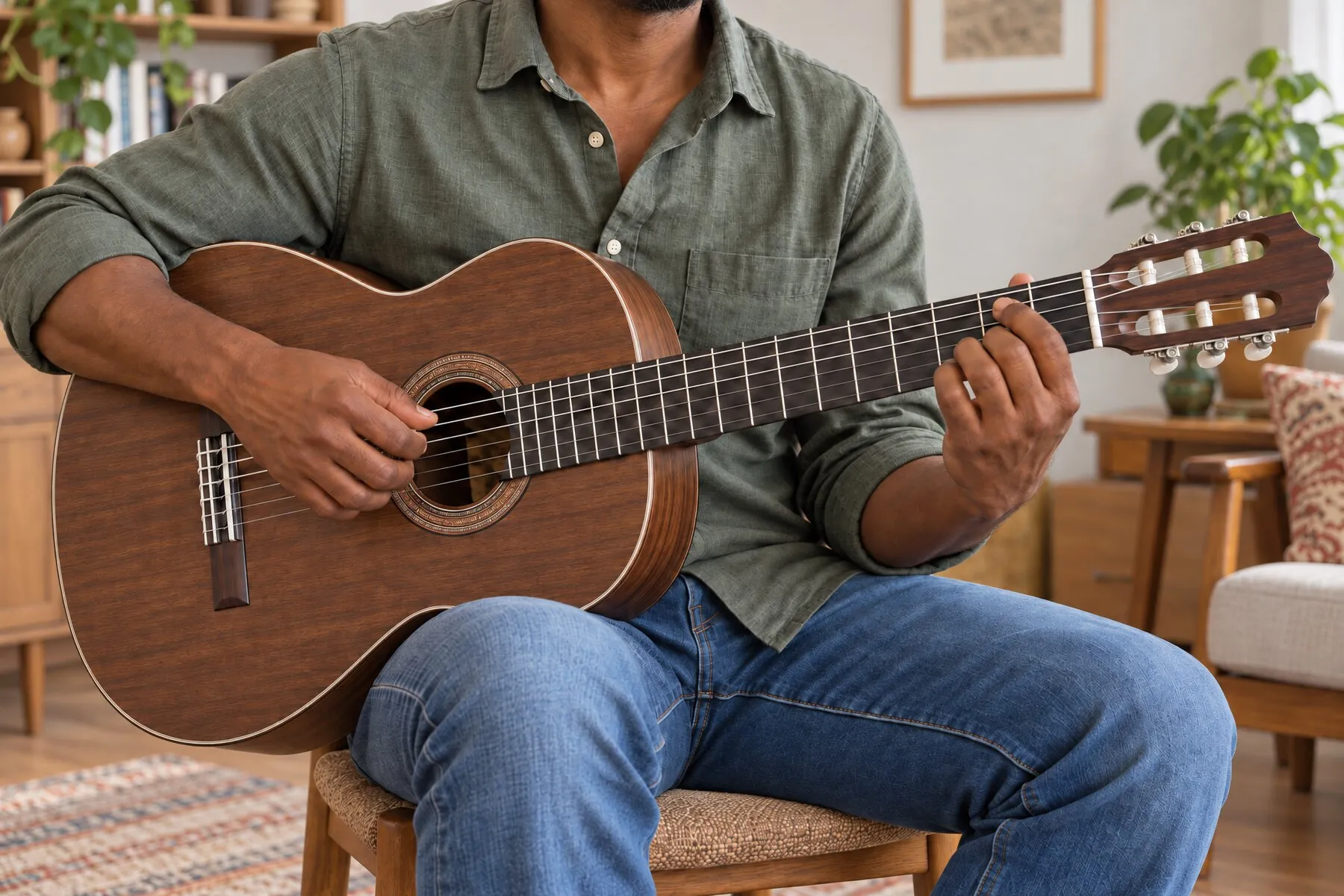
Sit upright with the guitar's body close to you and the neck pointing slightly up. Tune the six strings; then it's time for your first song.
- Days 2 and 3: the high E string
Play the open high E string, then F at the first fret with your first finger and G at the third fret with your third finger.
- Days 4 and 5: the B string
On the B string, the second-thinnest, play B open, C at the first fret and D at the third. That gives you six notes for short melodies.
- Days 6 and 7: your first chord
Place your second and third fingers at the second fret of the A and D strings: that is E minor. Count 1, 2, 3, 4 and strum all six strings with one even down-stroke on each beat. Stay with a step until it feels secure; your fingertips set the pace.
Beginner mistakes, and how to fix them
- A guitar that slips away
If the body slides down or the neck points to the floor, your fretting wrist bends sharply and your fingers can't reach the strings.
What helps: Keep the neck slightly raised and the body close to you. A strap holds the guitar in place, and in the classical position, with the guitar on your left thigh, a footstool under your left foot helps. A mirror shows you now and then whether the neck stays up.
- Building chords one finger at a time
Placing each finger separately makes every change slow, and the beat has to wait.
What helps: Look at the whole shape, then lift all fingers together and set them down together, a few times in a row, before you strum.
- Gripping the pick too hard
A tight grip stiffens your strumming arm, makes the sound harsh and lets the pick catch on the strings.
What helps: Hold the pick between your thumb and the side of your index finger with only its tip showing, and strum from a loose wrist.
Handy for week one
- Learn guitar with tonestro
- Will I really play my first song in 10 minutes?
- How does tonestro hear me play?
Beginner questions
Which guitar chords should a beginner learn first?
E minor and A minor need just two and three fingers, so they make a gentle start. C, G and D come next, each with a new finger shape and new changes to practice.
Should I strum with a pick or my fingers?
Both are fine. A thin pick gives a bright, even strum on steel strings; fingers and thumb sound softer and suit nylon strings well.
How do I read guitar tabs?
Tab shows the six strings as lines, with the thinnest string on top. A number tells you which fret to press, and 0 means the open string.
What is a capo for?
A capo clamps all strings at one fret and raises their pitch. You keep your easy chord shapes and play songs in a higher key, for example to suit a singer's voice.
Updated: