
Your start at a glance
- You need
- Your flute, a music stand at eye level and tonestro.
- First notes
- B4, A4 and G4: your left hand, plus your right little finger.
- First song
- Ten minutes: one or two notes, a real song, a band behind you.
- First goal
- The easy Symphony No. 40, which needs just those three notes.
Your plan for the first week
- Day 1: a first sound, then the whole flute
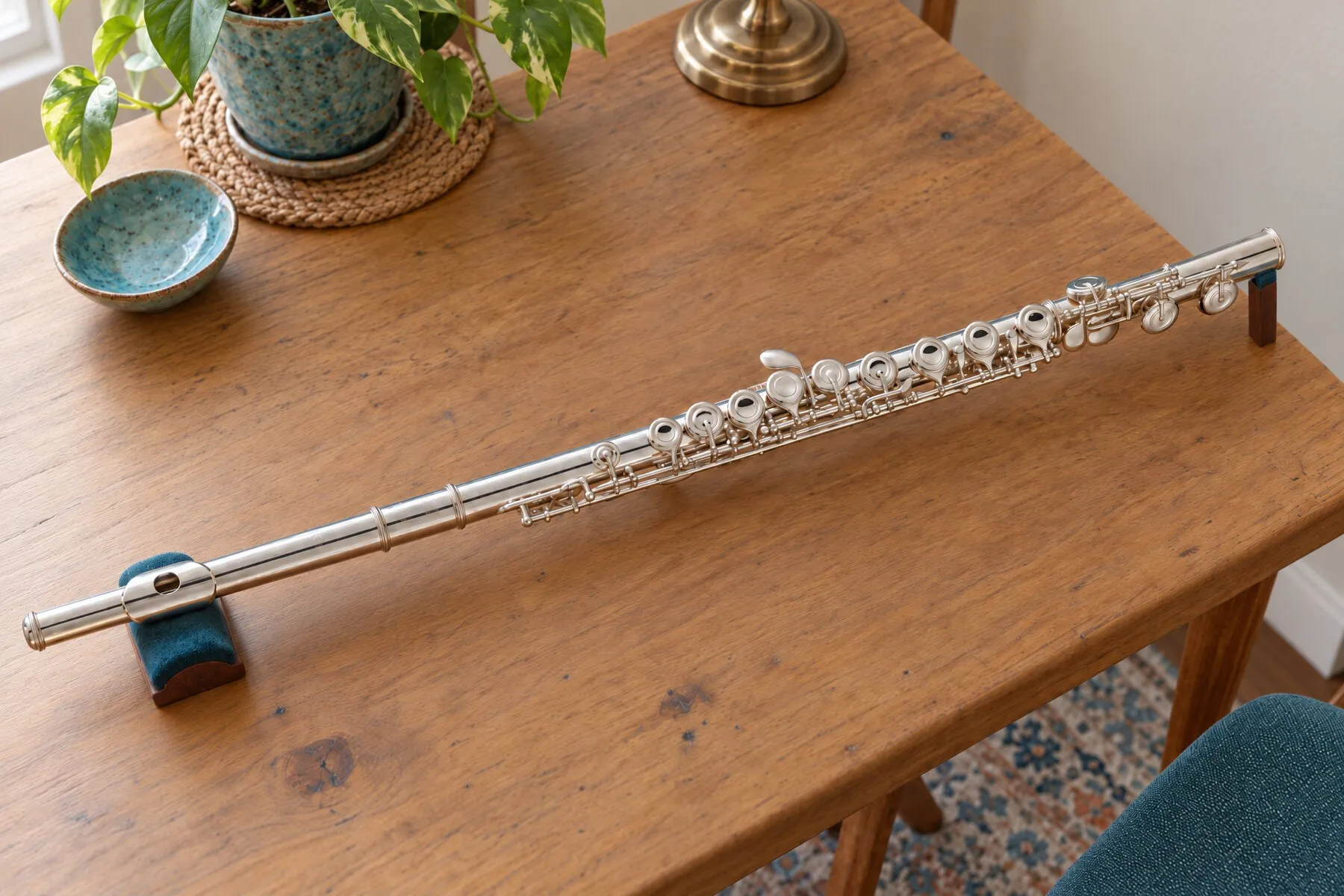
Try the head joint on its own first: rest the lip plate against your lower lip and blow a narrow stream of air across the hole, as over a bottle. Then fit the three parts together with a gentle twist, holding them by the tubes, not by the keys. Line up the embouchure hole with the keys and point the foot joint's rod to the middle of the lowest key on the body; now your first song is ready to go: one or two notes, with a band.
- Days 2 and 3: B4
For B4, your left thumb presses the B key (not the Bb lever beside it), your left index finger presses its key, and your right little finger holds down the Eb key. Hold the note for four slow beats, rest, and play it again.
- Days 4 and 5: A4 and G4
Add your left middle finger for A4 and your left ring finger for G4. As you move between the three notes, let the air keep flowing.
- Days 6 and 7: a three-note song
Play the easy version of Symphony No. 40, which uses only G4, A4 and B4, at 60 percent speed first. Go faster when every note comes out clear. If a step needs a few more days, give it those days; your sound grows with every session.
Beginner mistakes, and how to fix them
- A misaligned foot joint
If the foot joint is turned too far, your right little finger has to stretch for its keys, and the whole hand tenses up.
What helps: Start with the rod pointing to the middle of the lowest key on the body, then turn it a little until your little finger reaches its keys without stretching.
- The head joint pushed all the way in
Many flutes are tuned to be played with the head joint pulled out a few millimeters. Pushed in all the way, your notes tend to sound sharp.
What helps: Pull it out a little, check a comfortable note with the flute tuner in the app and adjust: out to go lower, in to go higher. Do this once your tone is steady.
- Squeezing the keys
A tight grip makes your fingers slow and pulls the flute out of position.
What helps: The keys close with light pressure. Press just enough for a clear note, and tonestro shows you right away whether it sounded right.
Your first flute songs
Start with few notes. These six are part of tonestro's 63 easy flute songs:
- Symphony No. 40
- Hot Cross Buns
- Happy Birthday
- Joshua Fit the Battle of Jericho
- Old MacDonald Had a Farm
- Danse macabre
Beginner questions
Where are my first flute notes on the staff?
G4 is on the second line up, A4 in the space above it and B4 on the middle line. Each step up alternates between line and space.
How should I breathe when I play the flute?
Breathe in through your mouth at the end of a phrase, letting your belly and lower ribs move while your shoulders stay down. The flute uses more air than it seems, so plan a breath before long notes.
Can I leave my flute assembled between sessions?
For short breaks, yes, on a flute stand. After practice, dry it and put it back in its case.
Do I need a B foot as a beginner?
No. Student flutes usually come with a C foot, whose lowest note is C4; a B foot adds B3 and matters later, if at all. More on choosing a flute: Learn the flute as an adult.
Updated: