
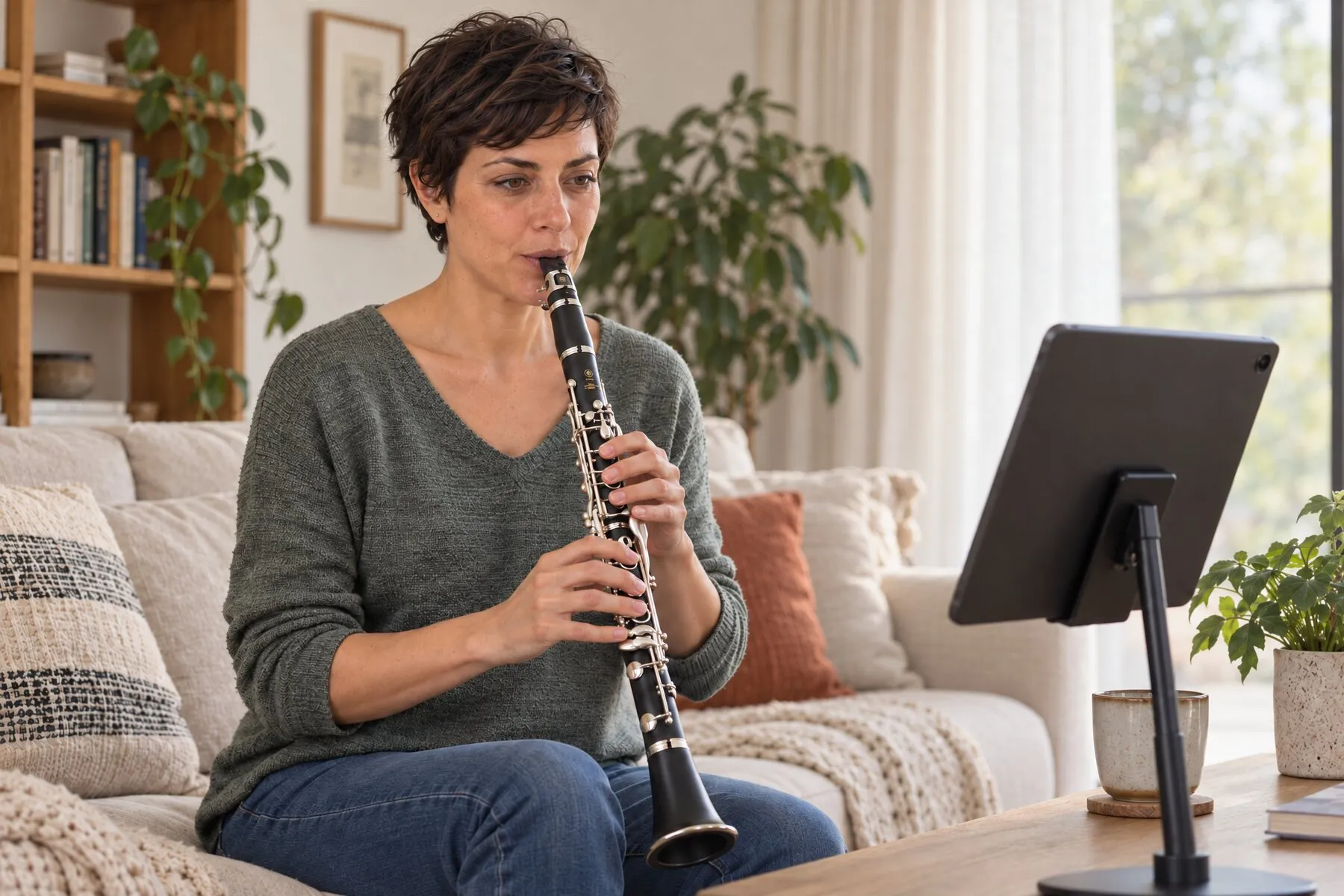
What you can do on your own
- Look up fingerings. The app includes fingering charts for the Boehm and the German system, so you can look up new notes as you meet them.
- Check every note. tonestro hears the pitch and timing of each note, even with nobody else in the room. A mirror helps you check finger position and chin shape.
- Practice on your schedule. Early morning or late at night, ten minutes or forty: you decide when and where, with no appointments to keep.
Typical self-study mistakes
- Biting the mouthpiece
Without anyone watching, many self-learners push the jaw up against the reed. The tone turns thin and pinched, and your lower lip gets sore.
What helps: Check your embouchure in a mirror now and then: firm corners, flat chin, relaxed jaw. Let your air do the work.
- Squeezing the clarinet
A tight grip feels safe, but it stiffens your fingers and makes the holes harder to seal.
What helps: Let your right thumb carry the clarinet under the thumb rest, and keep your fingers light and close to the holes. A short video of yourself shows whether they stay close.
- Playing on a worn-out reed
A damaged reed, or one too soft for your mouthpiece, can spoil response and tone, and it's easy to blame yourself instead.
What helps: Rotate three or four reeds, keep them in a reed case and replace any reed with a damaged tip.
Your practice week
- Early in the week: a new note
Look up its fingering in the app's chart, then pick an easy song from the library that uses it.
- Next session: the rhythm
Count a tricky bar in its time signature, out loud or in your head, before you play it.
- Midweek: a mirror check
Hold a few long notes in front of a mirror, with short breaks, and watch your corners, chin and jaw.
- Later in the week: the whole song
Play the song from start to finish at a tempo where it stays steady, and let small slips go.
- End of the week: look back
Play last week's song once more and notice what feels easier now.
Songs to practice on your own
Pick from 63 easy clarinet songs in tonestro, for example these:
- Where Did You Sleep Last Night
- Joshua Fit the Battle of Jericho
- Danse Macabre
- Ode to Joy
- Old MacDonald Had a Farm
- Happy Whistling Ukulele
Self-study questions
Can you teach yourself the clarinet?
Yes. With feedback on every note and courses made by music teachers, you can learn the clarinet on your own. More on that: learning without a teacher.
Boehm or German system: does it matter?
Practice on the clarinet you own. Some beginner notes are fingered the same way on both systems, others differ, so use the fingering chart for your system: tonestro includes both.
How do I know I'm playing in tune without a teacher?
Right after each note, tonestro shows you whether it was in tune and in time. Here's how tonestro hears you play.
How long does it take to teach yourself the clarinet?
Even your first ten minutes end with a real song: you play one or two notes, and a band plays along. After that, your pace depends on how often you practice, and our clarinet timeline gives you honest ranges.
Updated: