
Bass clef in brief
- Other name
- F clef: its two dots frame the line of F3, the fourth from the bottom.
- Octave numbers
- The staff runs from G2 on the bottom line to A3 on the top line; middle C is C4.
- Who reads it
- Cello, trombone, tuba, euphonium reading concert-pitch notation and, on the piano, usually the left hand.
- Your way in
- Learn three anchor notes, then play them on your instrument.
The notes in bass clef
Mnemonics and a trick
- The lines. For example, “Good Boys Do Fine Always” for G, B, D, F, A from the bottom.
- The spaces. For example, “All Cows Eat Grass” for A, C, E, G from the bottom. Feel free to make up your own sentence; only the first letters have to match.
- The trick from treble clef. At the same spot on the staff, the bass clef note is two letters further along the alphabet than the treble clef note: E becomes G, and F becomes A, because the letters start over at A after G. The octave changes too: the bottom line is E4 in treble clef but G2 in bass clef, almost two octaves lower; the second space is A4 in treble clef and C3 in bass clef.
Who reads bass clef
- Cello: Its four open strings span the staff: C2 on the second ledger line below, then G2, D3 and A3 on the bottom, middle and top lines. More on learning the cello and in the cello fingering chart.
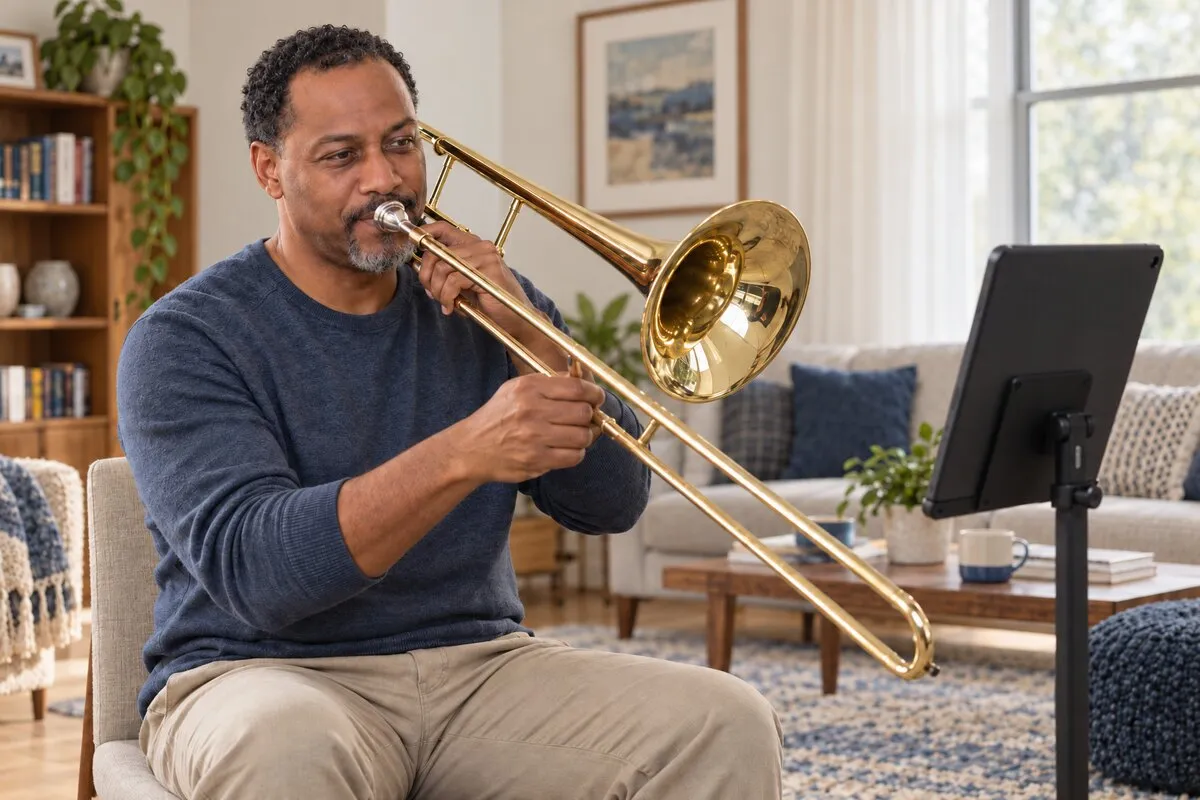
- Trombone: Trombone music is usually written in bass clef; the trombone slide positions show which position goes with which note. More on learning the trombone and in trombone sheet music.
- Tuba: Tuba music is usually written in bass clef, and in tonestro it always is: for every tuba version, in songs and in the theory course. More in tuba sheet music.
- Euphonium: In tonestro, euphonium music uses either concert-pitch notation in bass clef or transposing notation in Bb in treble clef. Find pieces in euphonium sheet music in bass clef.
- Piano: Piano music normally uses two staves, the grand staff; the lower one, often in bass clef, is mostly for the left hand. More on learning piano and piano keys with note names.
How to practice bass clef
- Three anchor notes.
Remember G2 on the bottom line, F3 between the clef's two dots, and C4 on the ledger line above the staff. Count your way to the other notes in the picture from these three.
- Lines first, then spaces.
Practice the five lines with your mnemonic, then the four spaces. Say each name out loud before you play the note.
- Straight to your instrument.
Play every note you read right away: on the cello, for example, G2, D3 and A3 on open strings; on the trombone with the matching slide position and embouchure; on the piano with your left hand on the matching key. Mind the octave as you go.
- Regularly, with feedback.
Keep at it in short, regular sessions. As you play in tonestro, every note gets instant feedback on pitch and rhythm, and you can show note names in the settings until you read with confidence.
Questions about bass clef
What are the notes in bass clef?
On the lines from the bottom: G2, B2, D3, F3 and A3; in the spaces: A2, C3, E3 and G3; above the staff come B3 and C4. Going down, F2 sits just below the bottom line, E2 on the first ledger line, D2 below it and C2 on the second ledger line.
What is the difference between treble clef and bass clef?
The treble clef shows higher notes, and its curl marks G4; the bass clef shows lower notes, and its dots mark F3. The two meet at middle C, C4: in treble clef it sits on the first ledger line below the staff, in bass clef on the first ledger line above.
How do I convert bass clef to treble clef?
When you rewrite a part, pitch and octave stay the same; only the spot on the staff changes. A3 from the top line of the bass clef sits on the second ledger line below the treble staff, and G2 from the bottom line all the way down on the sixth. If you write a part an octave or two higher for a higher instrument, it also sounds higher.
Why is bass clef so hard?
If you already know treble clef, the familiar spots can trip you up at first, because different notes sit there in bass clef. Lean on the anchor notes, and over time you'll read without the detour through treble clef.
Updated: