
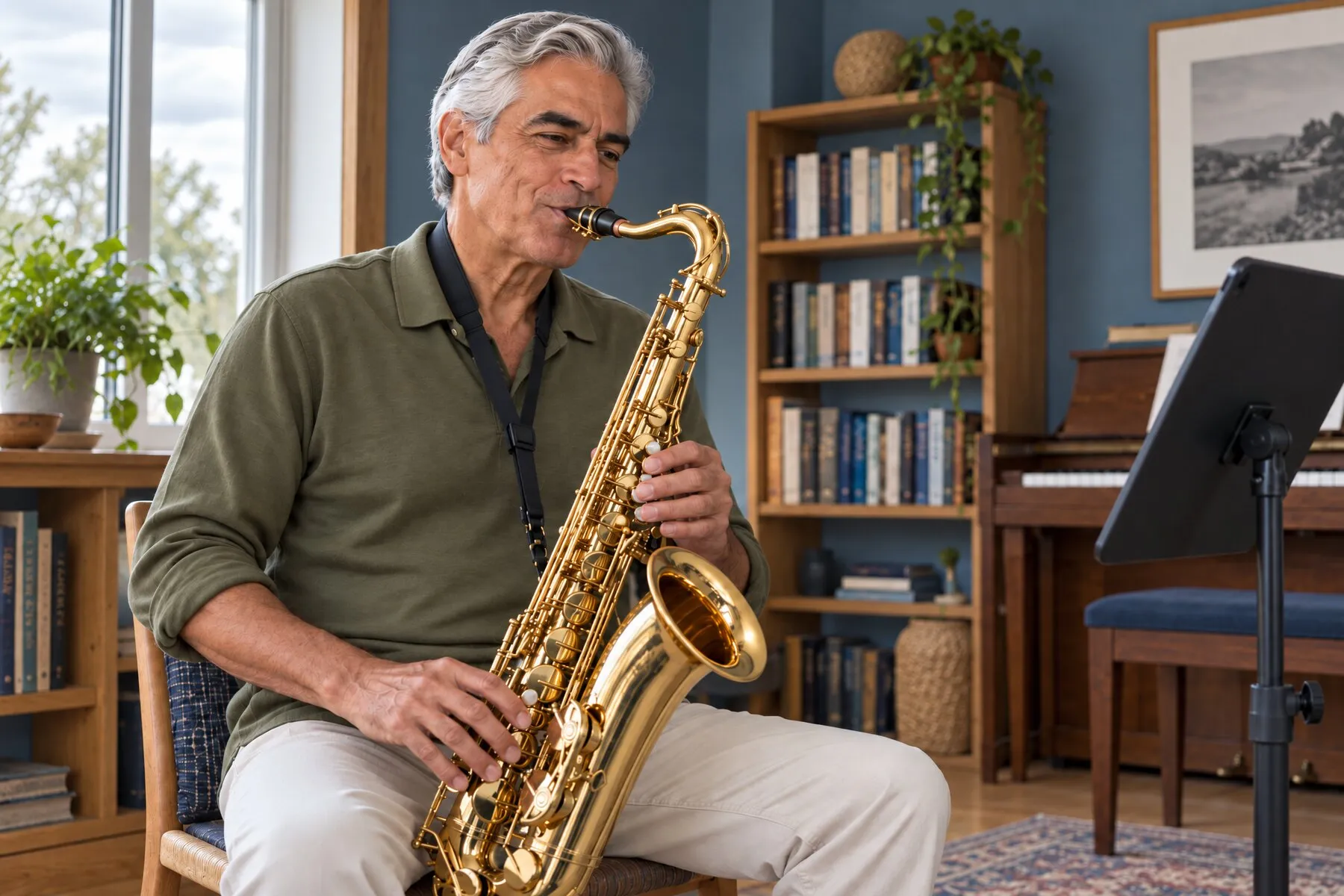
Your start at a glance
- You need
- Your saxophone, reeds, a neck strap and tonestro.
- First sound
- A written B4 with one finger of your left hand.
- First song
- Ten minutes in: one or two notes while a band plays a real song.
- First goal
- Written G4, A4, B4 and C5, all with the left hand.
Your plan for the first week
- Day 1: reed, mouthpiece, first song
Moisten the reed, lay its flat side on the mouthpiece with the tip just below the mouthpiece tip, and tighten the ligature gently. Hang the sax on its neck strap with your right thumb under the thumb hook. Rest your upper teeth on the mouthpiece, cushion your lower teeth with your lower lip and blow a steady stream of air without biting. Then your first song is waiting: one or two notes along with a band.
- Days 2 and 3: your left hand
Rest your left thumb on its thumb rest and play written B4 with your first finger, A4 with two fingers and G4 with three. Hold each note for four slow beats.
- Days 4 and 5: add C5
Written C5 needs only the second finger of your left hand. In tonestro's easy version of Happy Birthday, these four notes, G4 to C5, are all you need.
- Days 6 and 7: the right hand joins
Finger G4 again with three left-hand fingers. Then add your first right-hand finger for written F4, and your second one as well for E4. Stay with a step until the notes sound steady, then move on.
Beginner mistakes, and how to fix them
- A crooked reed
If the reed sits off to one side or too high, the saxophone answers with a hiss, a squeak or nothing at all.
What helps: Center the reed on the mouthpiece and line its tip up with the mouthpiece tip, so only a hairline of mouthpiece shows beyond it.
- The thumb on the octave key
Many beginners rest the left thumb on the octave key or lift it off completely. Notes then jump up an octave, or the thumb can't find the key in time.
What helps: Rest the thumb on the thumb rest below the octave key and roll it onto the key only when a note needs it.
- Fingers flying high
Lifting your fingers far above the pearl keys makes every change slow and uneven.
What helps: Keep your fingertips in light contact with the pearls, without pressing the ones you don't need. tonestro hears whether each change came in time; a mirror shows how far your fingers lift.
Easy songs for your first weeks
Start with Happy Birthday; the others all add written D5, which you play with both hands and the octave key. All are among the 62 easy alto sax songs in tonestro:
- Happy Birthday
- Hot Cross Buns
- Danse macabre
- Happy Whistling Ukulele
- Oh Shenandoah
- Whiskey in the Jar
Beginner questions
I have a tenor sax. Does this work for me too?
Yes. Fingerings and first steps are the same; the tenor takes a bigger reed and more air, and its written notes sound a major ninth lower. tonestro has easy songs for tenor too. Choosing between the two: Learn saxophone as an adult.
Is it better to rent or buy a saxophone at first?
Renting means you can start without committing, and some music shops count part of the rent toward a later purchase. If you buy, take someone who plays along, or have a repair shop look at the instrument first.
How do I hold the saxophone when I sit?
Many alto players hold the sax in front of them or slightly to the right side; the larger tenor usually rests at your right side. Sit on the front half of the chair with both feet on the floor.
What is a mouthpiece patch?
A thin rubber pad you stick on top of the mouthpiece. It keeps your upper teeth from slipping and protects the mouthpiece.
Updated: