
D Major Scale on Clarinet
T thumb hole R register key
How to play it
D Major Scale: notes and fingerings
Two sharps, F♯ and C♯. On a B♭ clarinet it sounds as concert C Major. It crosses the break from A to B, so the register key comes in halfway up.
Written notes for B♭ clarinet. The table shows the Boehm system. For the German system, use the switch next to the clarinet in the tool. T is the thumb hole, R the register key, the dots your six finger holes. Tap any note in the tool to hear it.
How to read the fingerings
T is the thumb hole, R the register key, both on the back. The dots are the six finger holes: left hand on top, right hand below. Filled means closed.
Your C sounds B♭
The notes here are written for B♭ clarinet, which sounds one whole step lower. So the F Major Scale is the concert E♭ Major Scale your band plays.
Start slowly
Begin at 60 BPM with the click on. Play every note full and steady. Speed up only when it feels easy.
 tonestro
24 clarinet scales in the tonestro app
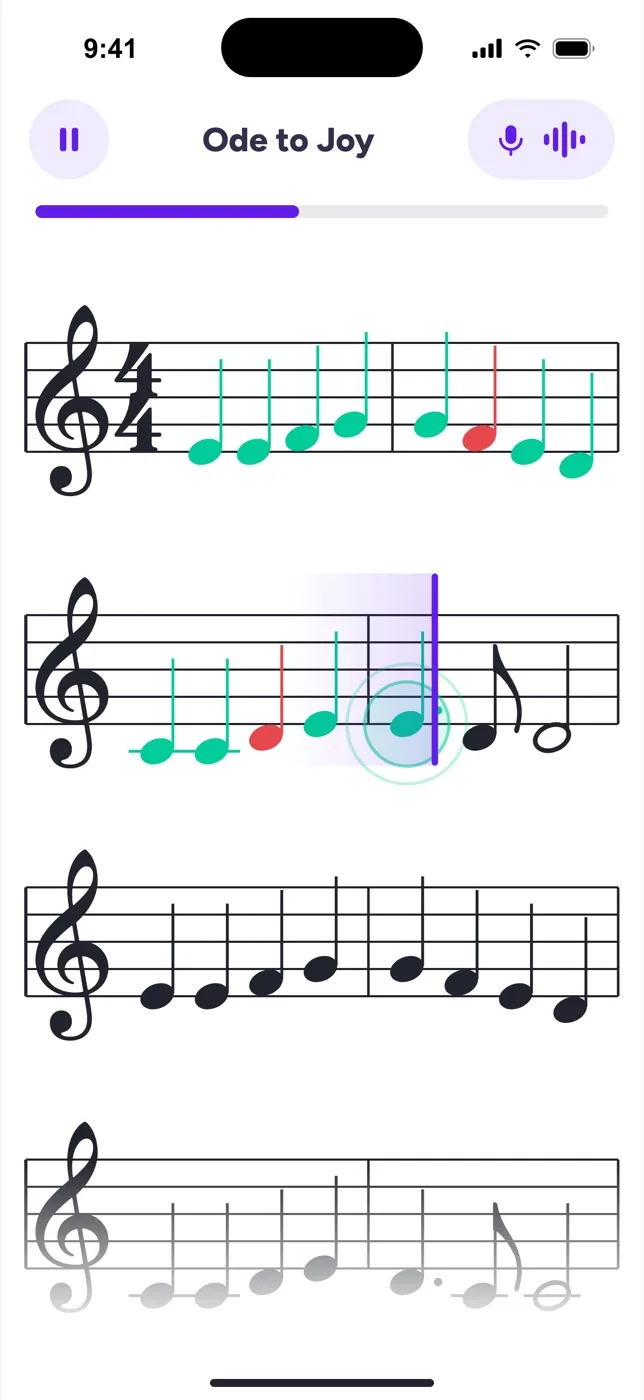
Play along and finally know if it's right. Right notes turn green. Missed one? Play it again.
Questions about the D Major Scale
What are the fingerings of the D Major Scale on clarinet?
Boehm system: D4: thumb, LH 1 2. E4: thumb, LH 1. F♯4: LH 1. G4: open. A4: A. B4: thumb, register key, LH 1 2 3, RH 1 2 3, LH E/B. C♯5: thumb, register key, LH 1 2 3, RH 1 2 3, RH F♯/C♯. D5: thumb, register key, LH 1 2 3, RH 1 2 3. E5: thumb, register key, LH 1 2 3, RH 1 2. F♯5: thumb, register key, LH 1 2 3, RH 2. G5: thumb, register key, LH 1 2 3. A5: thumb, register key, LH 1 2. B5: thumb, register key, LH 1. C♯6: thumb, register key, LH 2 3, RH 1 2. D6: thumb, register key, LH 2 3, RH 1, RH A♭/E♭.
German system: D4: thumb, LH 1 2. E4: thumb, LH 1. F♯4: thumb. G4: open. A4: A. B4: thumb, register key, LH 1 2 3, RH 1 2 3, LH E/B, RH F/C. C♯5: thumb, register key, LH 1 2 3, RH 1 2 3, LH F♯/C♯, RH F/C. D5: thumb, register key, LH 1 2 3, RH 1 2 3. E5: thumb, register key, LH 1 2 3, RH 1 2. F♯5: thumb, register key, LH 1 2 3, RH 1. G5: thumb, register key, LH 1 2 3. A5: thumb, register key, LH 1 2. B5: thumb, register key, LH 1. C♯6: thumb, register key, LH 2 3, RH 1 2 3, RH A♭/E♭. D6: thumb, register key, LH 2 3, RH 1 3, RH A♭/E♭.
Is the D Major Scale the concert C scale?
Yes. A B♭ clarinet sounds one whole step lower than written, so the written D Major Scale sounds as concert C Major.
How do I cross the break from A to B?
A is a throat note, B the first note with the register key and all holes closed. Practice the two notes slowly back and forth.
Boehm system: A: Press the A key with your left index finger. Keep the thumb hole open. B: Cover the thumb hole and all six front holes. Press the E/B key with your left little finger and the register key with your thumb.
German system: A: Press the A key with your left index finger. Keep the thumb hole open. B: Cover the thumb hole and all six front holes. Press the E/B key with your left little finger, the F/C key with your right little finger and the register key with your thumb.
How do I read the fingerings?
T is the thumb hole and R the register key, both on the back of the clarinet. The six dots are the holes for your fingers: left hand 1 2 3 on the upper joint, right hand 1 2 3 on the lower joint. A filled dot is a closed hole. Extra keys are named in words.
Is this for the Boehm or the German system?
Both. The tool starts with the Boehm system, the standard outside Germany and Austria. Switch to the German (Oehler) system next to the clarinet: the drawing, the fingerings and the words change with it. The table on this page shows the Boehm fingerings.