
Quick Answer
Most beginners can learn to play very simple piano songs within a few weeks. Playing confidently with both hands usually takes several months of regular practice. After one year, many consistent beginners can play easier songs, read basic notation, understand simple chords, and practice more independently. The exact timeline depends on your goals, practice routine, previous music experience, and the difficulty of the music you choose.
What Does “Learn Piano” Mean?
The question “How long does it take to learn piano?” sounds simple, but the answer depends on what you mean by learning.
If you mean playing a few simple melodies, the timeline can be short. Many beginners can do that in the first weeks. If you mean reading music fluently, using both hands, playing with steady rhythm, and learning songs independently, the timeline is longer. If you mean advanced classical playing or confident performance, that takes years.
For beginners, it is more useful to think in milestones instead of one final finish line. Piano learning is not something you complete all at once. You build layers: note names, rhythm, hand position, reading, coordination, listening, and musical expression.
The good news is that you can make real music early. You do not need to wait years before piano feels rewarding.
Beginner Piano Timeline
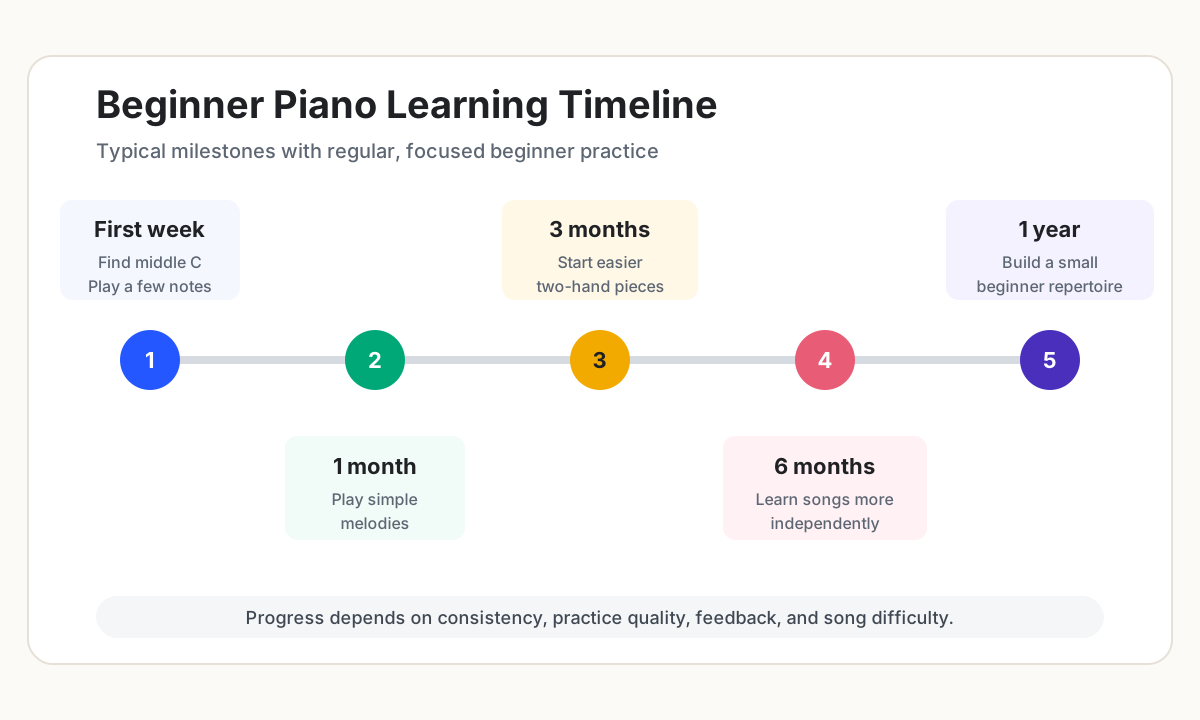
This timeline assumes regular short practice, beginner-friendly music, and a clear learning path.
| Time Learning Piano | Realistic Beginner Milestone |
|---|---|
| First week | Find middle C, understand the black-key groups, play a few notes slowly |
| 1 month | Play simple melodies, name the white keys, count basic rhythms |
| 3 months | Play easier two-hand pieces, read a small note range, practice with more structure |
| 6 months | Learn simple songs more independently, use basic chords, keep steadier rhythm |
| 1 year | Play a small beginner repertoire, read easier music, understand practice problems more clearly |
This is not a strict schedule. Some learners move faster in one area and slower in another. A beginner might read notes well but struggle with rhythm. Another might play by ear comfortably but need more time with notation. That is normal.
What You Can Expect After The First Week
In the first week, the goal is not to sound polished. The goal is to become familiar with the instrument.
A good first-week goal is to learn the repeating pattern of black keys, find C and F, and play a few neighboring notes. You might practice finding middle C, playing C-D-E-F-G with one hand, and keeping your shoulders relaxed.
This stage can feel awkward because everything is new. Your eyes are learning the keyboard, your hands are learning the distance between keys, and your brain is trying to connect note names with movement.
Keep the first week simple. If you can sit at the piano, find a few notes, and play slowly without tension, you are already building the foundation.
What You Can Expect After One Month
After one month of regular beginner practice, many learners can play a few simple melodies. They may recognize the white-key note names, understand middle C, count quarter notes and half notes, and play short exercises with each hand.
At this stage, the music should still be easy. Beginner progress comes from accuracy, repetition, and confidence, not from choosing impressive pieces too soon.
Useful one-month goals include:
- Find C, D, E, F, G, A, and B on the keyboard.
- Play a simple melody with the right hand.
- Add one easy left-hand note at the start of each measure.
- Count simple rhythms out loud.
- Practice for 10 to 20 minutes without feeling overwhelmed.
If both hands still feel difficult after one month, that is not a problem. Two-hand coordination is one of the main skills beginners are building.
What You Can Expect After Three Months
After three months, a consistent beginner may be able to play easier two-hand pieces. The left hand is usually still simple, but it starts to feel less mysterious.
This is also when many beginners notice that reading music is becoming more familiar. They may not read quickly yet, but they can recognize landmarks like middle C, treble G, and bass F. They can also use nearby notes to count step by step.
Three months is a good time to build a repeatable practice routine. Instead of only playing songs from start to finish, practice should include small sections, slow repetition, rhythm work, and review.
If you want a practical structure, use a short routine like this:
- Warm up for a few minutes.
- Practice one skill, such as note reading or rhythm.
- Work on one small section of a song.
- End by reviewing something you can already play.
For more detail, see 15-Minute Piano Practice Routine for Beginners.
What You Can Expect After Six Months
After six months, many beginners can learn simple songs with more independence. They may understand basic chords, recognize repeated patterns, and know how to slow down difficult sections.
This is often when practice starts to feel more musical. Simple pieces can sound steadier. Rhythm becomes less random. Hands may coordinate more naturally.
Six months does not mean everything feels easy. It means you have enough experience to understand problems more clearly. Instead of thinking “I am bad at piano,” you might notice “my left hand enters late” or “I need to count this rhythm before playing.”
That change matters. Clear problems are easier to fix.
What You Can Expect After One Year
After one year of steady beginner practice, many learners can play a small set of easy songs, read beginner-level music, use simple chords, and practice with less help.
Adult beginners may also have a clearer sense of what kind of music they want to play. Parents may notice that a child has stronger rhythm, better listening habits, and more confidence at the instrument.
A realistic one-year beginner might still play slowly. They may still need help with harder pieces. But they should have a stronger foundation than when they started.
One year of piano does not make someone “finished.” It gives them a base for the next stage.
What Affects How Fast You Learn Piano?
The timeline depends on several factors.
| Factor | Why It Matters |
|---|---|
| Practice consistency | Short regular sessions usually beat occasional long sessions |
| Practice quality | Focused work on small problems builds skill faster than distracted repetition |
| Song difficulty | Beginner-friendly songs build confidence; difficult pieces can slow progress |
| Previous music experience | Rhythm, listening, or notation experience can help |
| Feedback | A teacher, app, or structured method can make the next step clearer |
| Physical comfort | Good bench height, relaxed hands, and low tension make practice easier |
The most important factor is consistency. A beginner who practices 15 minutes five days per week will usually make steadier progress than someone who practices for one hour once every weekend.
Quality matters too. Playing the same mistake quickly many times can make it stronger. Slow, careful practice is more effective.
Adult Beginner Timeline
Adults often ask whether they are too late to learn piano. They are not.
Adults can understand patterns, set goals, and practice deliberately. Those are real advantages. The challenge is usually expectation. Adults often want their playing to sound good immediately, and they may judge themselves harshly when it does not.
For adult beginners, a strong first goal is not speed. It is comfort: sitting at the piano regularly, finding notes, counting steadily, and playing simple music without panic.
If you are starting from zero, read How to Learn Piano for Beginners for a more detailed first path.
Child Beginner Timeline
Children can make excellent progress, but their timeline depends heavily on age, attention span, support, and practice environment.
Young children often do better with very short sessions. Five focused minutes can be more useful than 20 minutes of frustration. Parents can help by turning practice into small tasks:
- Find all the C notes.
- Clap the rhythm before playing.
- Play the first two measures slowly.
- End with a favorite easy song.
Parents should expect uneven progress. A child may seem to forget something one day and remember it the next. That does not always mean the practice failed. It often means the skill is still settling.
How To Make Progress Faster Without Rushing
The best way to learn faster is not to force harder music. It is to practice more clearly.
Try these habits:
- Practice most days, even if the session is short.
- Work on small sections instead of always starting from the beginning.
- Count rhythm out loud.
- Play slowly enough that your hands can succeed.
- Review easy music so confidence grows alongside new skills.
- Keep one note about what to practice tomorrow.
Beginners often improve fastest when the next step is obvious. If you do not know what to practice, choose the thing that blocks your current song: note names, rhythm, left hand, right hand, or coordination.
How To Know You Are Making Progress
Progress is not only playing harder songs. It can also mean:
- You find notes faster.
- You restart less often.
- Your rhythm feels steadier.
- Your hands feel more relaxed.
- You can explain what went wrong.
- You remember a short section from yesterday.
- You can practice without someone telling you every step.
These signs are easy to miss because they are small. But small improvements are exactly how piano learning works.
How tonestro Fits Into Piano Progress
Good music learning depends on structure, feedback, and regular repetition. tonestro is built around helping learners practice instruments with more clarity and consistency.
For piano beginners, the same principle applies: know what to practice, start with realistic music, listen carefully, and return often. A clear routine makes the timeline less mysterious because each practice session has a purpose.
Related Reading
- How to Learn Piano for Beginners
- Best Piano Keyboard for Beginners
- Piano Notes for Beginners
- 15-Minute Piano Practice Routine for Beginners
FAQ
Can I learn piano in 3 months?
You can learn basic piano skills in 3 months, including simple melodies, basic rhythm, and easier two-hand pieces. You should not expect advanced fluency in that time.
How long does it take to play piano with both hands?
Many beginners start simple two-hand playing within the first few months. Confident two-hand coordination usually takes longer and improves gradually with slow practice.
Is 30 too old to learn piano?
No. Adults can learn piano at 30, 40, 50, or later. Adults often learn well when they use realistic music, short regular practice, and clear goals.
How much should a beginner practice piano each day?
Ten to 20 focused minutes is enough for many beginners. Consistency matters more than long practice sessions at the beginning.
How long does it take a child to learn piano?
Children can often play simple songs within weeks or months, but steady progress depends on age, attention span, practice support, and suitable beginner material.
When will piano start to feel easier?
Many beginners notice the first real comfort after a few weeks of regular practice. Bigger changes often appear after 3 to 6 months, when note finding, rhythm, and hand coordination become more familiar.
Last updated